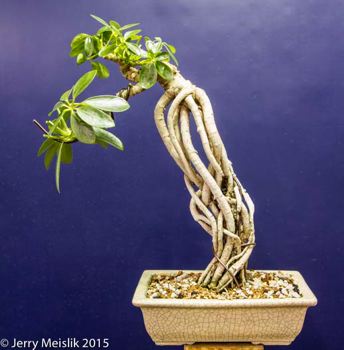
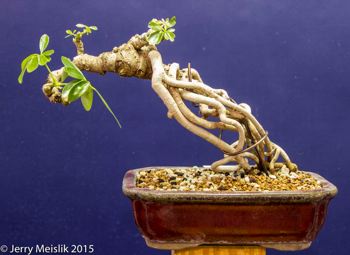
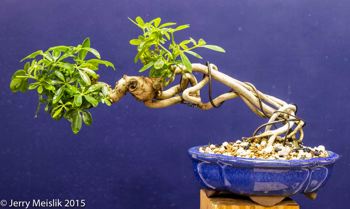
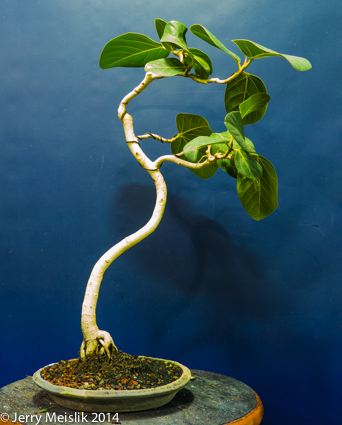
There are several instances in which I use a plastic bag to protect a fig bonsai.
For rooting cuttings
Stressed trees that need time to recover
Recently re-potted trees that have been struggling
To develop aerial roots on figs that require constant humidity for aerial
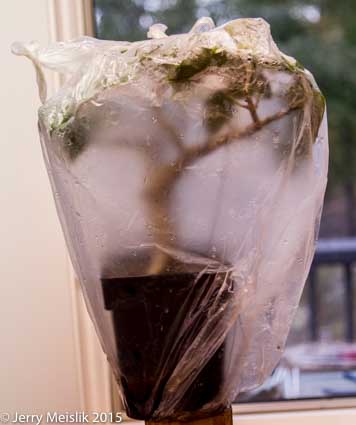
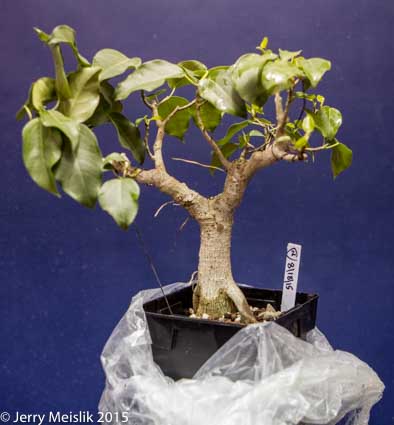
In this case this Ficus rumphii has had all its roots cut off and is basically a large cutting. It is place into the baggie, watered well and the bag is opened every few days to make sure that the soil is moist. Never let the pot sit in water or the plant or cutting will rot. Also keep the bag in bright light but never in direct sunlight.
Remove the bag once the plant is growing properly.
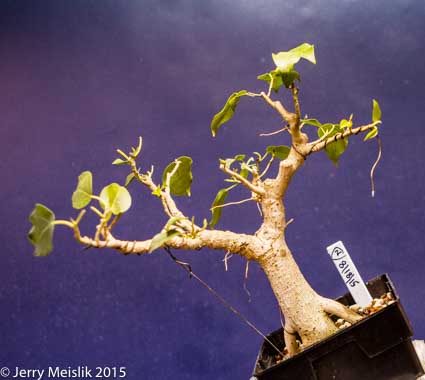
Ficus rumphii sealed in the bag after removing all of its rootsNow recovered and wtih enough roots to live outside the bag. Also showing new aerials have formed on the trunk
Bag is removed as the plant has new roots and can survive outside the bag
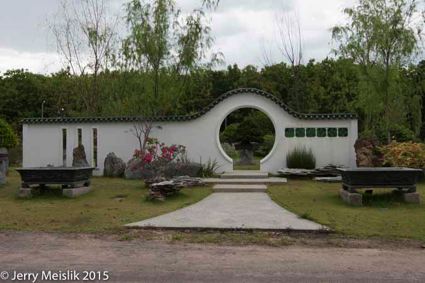
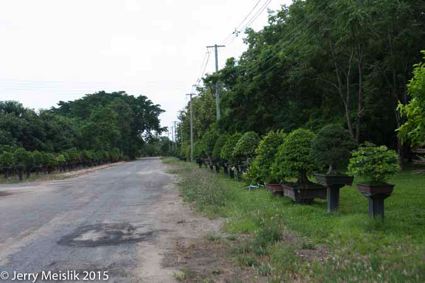
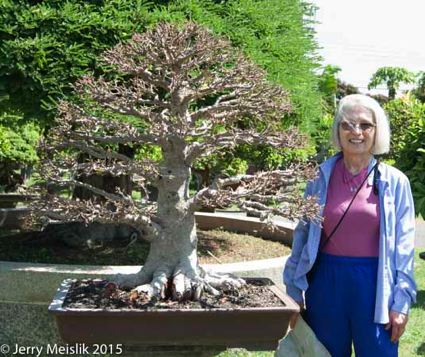
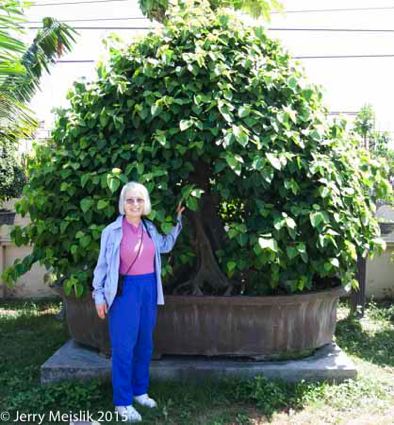
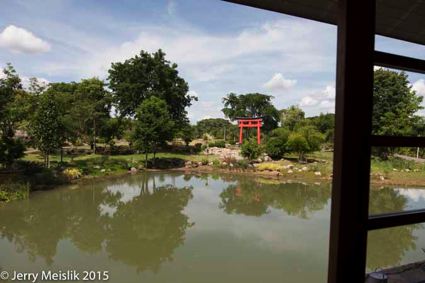
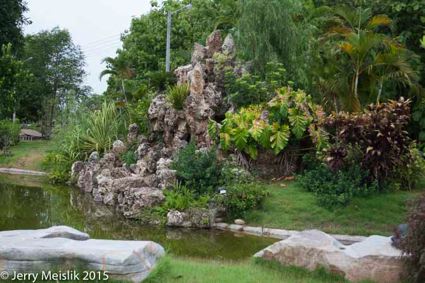
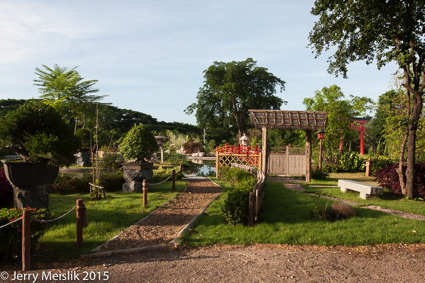
Entryway to the Chinese GardenEntryway road leading into the gardens is lined with large bonsai on either sideRhona standing beside a defoliated fig treeA large Ficus religiosaView across one of the lakesRockery and waterfall
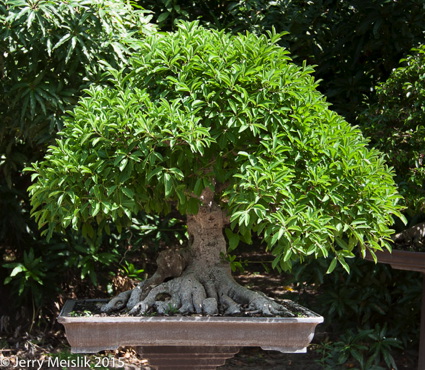
Beautiful strong rootage
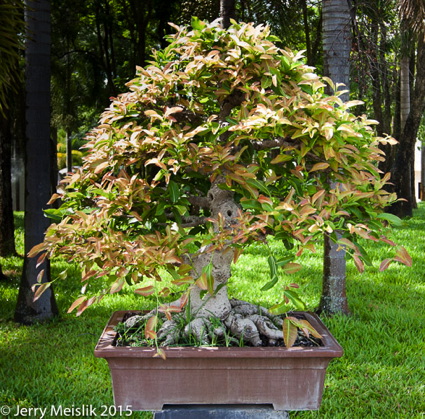
Ficus virens showing red newly grown leaves
One view of a section of the bonsai villageLovely rootage on this bonsaiRoot over rock designFicus virens nearly covering over the stoneRoot over rock design, defoliated treeHibiscus in full leaf
This was our fourth or fifth visit to Thailand which ranks high on our list of the most wonderful countries to visit. The country is beautiful and the people are all so very warm and hospitable. Of course we love Thai food and also the wide range of fresh tropical fruits and vegetables, including the legendary aromatic durian.
Our time in Thailand was spent with Montri and Jane Suksermongchai of Bangkok. They are good friends and have introduced us to many of the delights of the Thai country and culture.
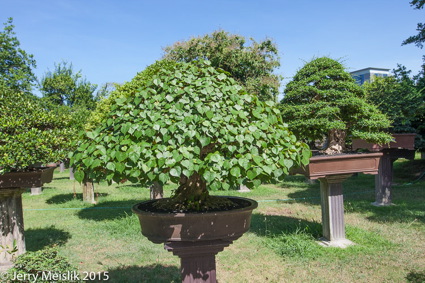
On this trip we had time to explore Montri’s bonsai collections in Bangkok as well as his nearly completed Bonsai Garden, Suanphung Bonsai Village. Suanphung is named after a local tree and is an extensive bonsai garden almost too big to walk around. It would take many hours to visit the numerous bonsai in the Chinese and Japanese gardens as well as bonsai lining both sides of the major roadways. There are also displays of garden stones, and newly constructed buildings. Needless to say there are also exquisite masterpiece bonsai including figs, Podocarpus, Adenium, Trident maple, Hibiscus, Wrightia religiosa, Tamarind and other species.
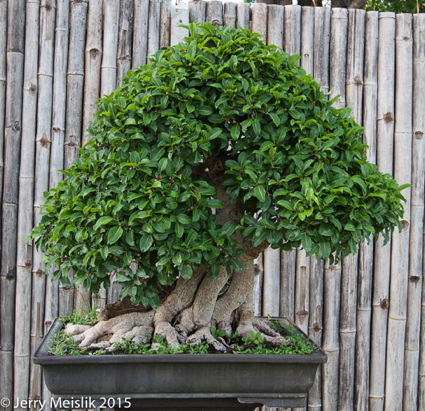
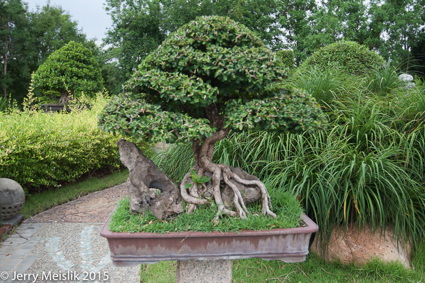
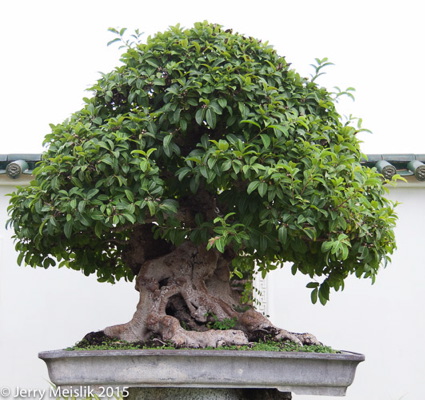
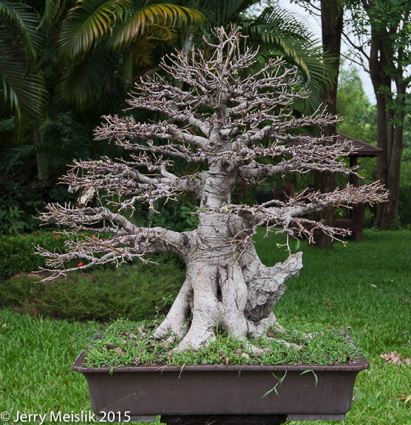
With my special interest in figs I was able to view many species used as bonsai including Ficus virens, microcarpa, benjamina, racemosa, religiosa and rumphii. Montri’s bonsai are in classical shapes and designs with the styles of bonsai varying from upright to cascade to root over rock. Many of the bonsai are of large or imperial size and not easily moveable by one or even two people. Pots are commensurately large and can be constructed of pottery, cement or carved from solid blocks of granite.
The individual gardens and buildings are done in elegant and tasteful designs consistent with the landscape and themes of the individual gardens while the quality of the bonsai is second to none in the world.
Once the gardens are completed a visit to them will be a must for any bonsai lover visiting Thailand.
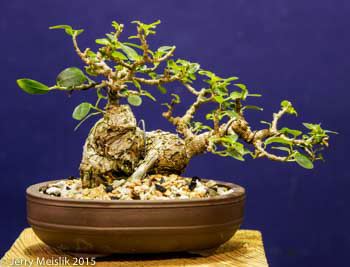
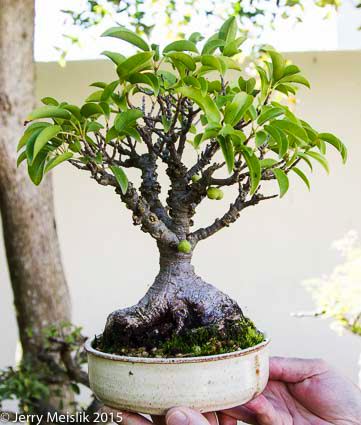
Ficus burtt-davyi is a fig that is found in the southern parts of Africa. There are several common variants of this material available to the bonsai community. There are large, medium and small leaf cultivars that can be found.
This is one of the small leaf cultivars.
It is a very small plant of perhaps 3-4 inches/10cm in size and one of my smallest bonsai.
It is a worthwhile addition to any fig lovers collection.
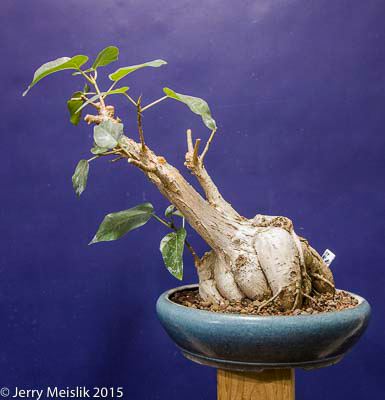
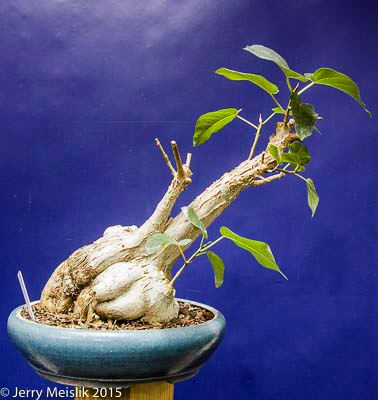
Ficus palmeri is a fig native to Baja and Mexico. It is often found growing in seasonally dry areas and adapts to times of drought by losing its leaves and storing water in its trunk. The trunk and basal roots are often found plastered over rocky areas with the roots draping down rock faces and into crevices in a search for water.
The leaves of this fig are relatively large with long peitoles and the tree’s nature is not to have very dense branching. This is a problem in getting this material to look tree-like and to respond to bonsai training and styling.
Ficus palmeri with a large water storing caudex and pretty sparse branchingViewed from the other side
Schefflera arboricola is one of the most suitable species for indoor bonsai growers. It tolerates low light and the errors of beginners in growing bonsai. It can also be grown in the most styles imaginable.
Roots are large and sturdy and can be used to form great bonsai with exposed roots.
My good friend David Fukumoto of Fuku-Bonsai has the best selection of amazing Schefflera for sale. See www.fukubonsai.com
Utilizing large leaf plants for bonsai is difficult. There are various techniques to deal with plants that have large leaves, like Ficus benghalensis.
The first shot shows the tree with its various sized leaves. These are large but already reduced just by being grown in a small container.
Ficus benghalensis with leaves that are too large
The second shot shows the tree in a defoliated state. In this leafless condition the branching and structure can be studied and analyzed. The bunjin/literati style is now appreciated once the distraction of the large leaves is removed, albeit temporarily. Once the new leaves grow out they will be smaller but eventually the newest leaves will grow out as full sized and ruin the illusion once again.
Defoliated the bunjin character and style of the tree can be analyzed and the scale of the design is now appropriate
The definitive reference work on Ficus
for bonsai. The book is a softcover, 8 by 10 inch volume, with 144 color pages, containing detailed information for the beginner as well as the advanced hobbyist.
One of the ways that I obtain material that is not commercially available is to find seed of rare species. Growing from seed is not the fastest or easiest way to obtain bonsai but it does allow one to exert complete control over the development of a bonsai.
While there are many ways to sprout seed I am currently sprouting my fig seed by sowing the seed on the surface of rock wool plugs. These plugs are available online or from garden centers.
The plug is kept in a shallow dish with a bit of water in the dish. This keeps the plug from drying out. Ficus seed take somewhere from 1-12 weeks to sprout or even longer. Plants are kept growing on this plug until they have 4-5 leaves on each sprout.
Once the seed has sprouted and two or three leaves have appeared the plugs can be placed into a bonsai soil mix. The surface of the plug should be 1/4-1/2 inch above the surrounding soil mix and allowed to grow for a year. Once the seedlings are quite sturdy with about 8 leaves on each one they can easily be removed from the plug and rooted into a pot of bonsai soil.
It normally takes 3-4 years from seed to get a plant large enough to begin bonsai training, so the process is not for the impatient bonsai grower.
Click below to read more details about seed growing.
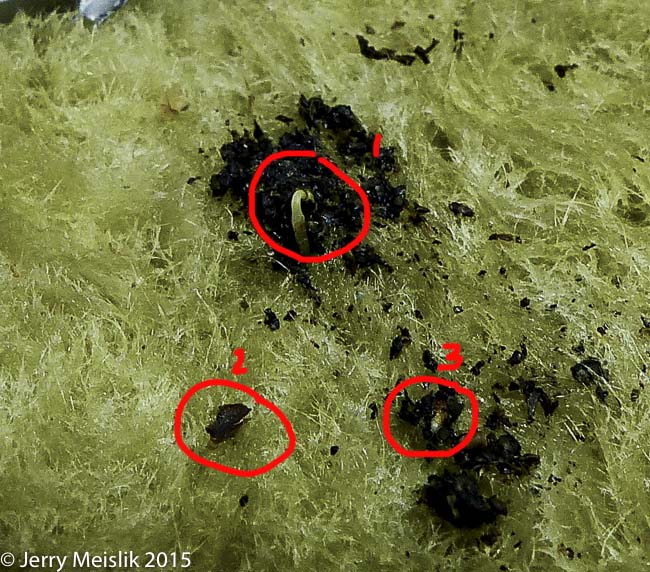
Ficus tremula growing on top of a rock wool plug, Three weeks after sowing, several sprouting seeds are outlined in red.
The definitive reference work on Ficus
for bonsai. The book is a softcover, 8 by 10 inch volume, with 144 color pages, containing detailed information for the beginner as well as the advanced hobbyist.
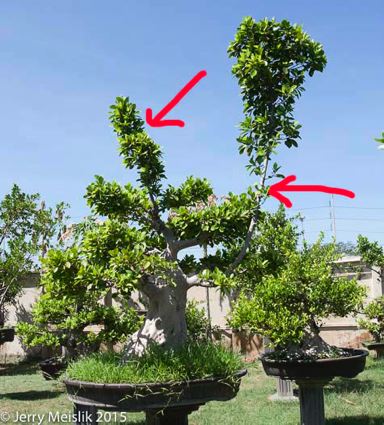
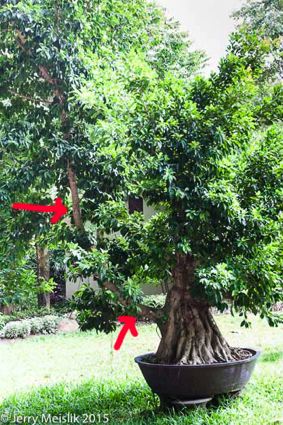
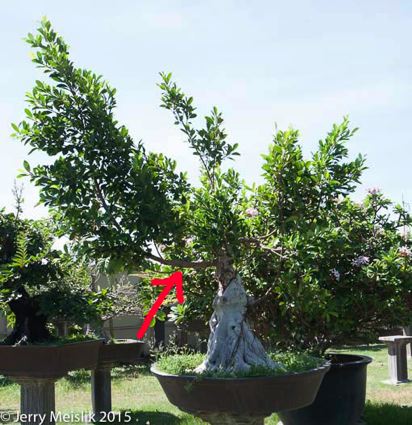
Often a branch on a bonsai is too thin. To thicken it allow it to grow wildly without trimming it back. Keep the rest of the tree trimmed as normal.
Once the branch is of the proper thickness it can be shortened back and proper taper and ramification can be developed.
Red arrows point to the thickening branch
z
The definitive reference work on Ficus
for bonsai. The book is a softcover, 8 by 10 inch volume, with 144 color pages, containing detailed information for the beginner as well as the advanced hobbyist.
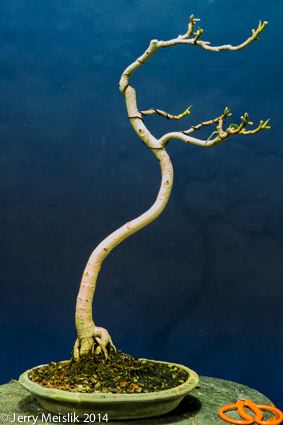
On a visit to South Africa I saw a very interesting fig, Ficus tremula, shaped as a small bonsai in the bonsai collection of my friend Hennie Nel.
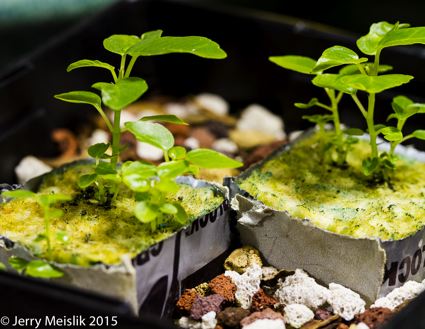
I was unable to find Ficus tremula for sale in the US so I am resorting to growing them from seed. It will take many years for these now two month old seedlings to mature into a reasonable bonsai. Growing from seed is for the young and those with lots of patience.
Ficus tremula bonsai grown by Hennie Nel of South Africa
Ficus tremula at two months of age grown from seed
For more information on growing figs from seed see:
The definitive reference work on Ficus
for bonsai. The book is a softcover, 8 by 10 inch volume, with 144 color pages, containing detailed information for the beginner as well as the advanced hobbyist.
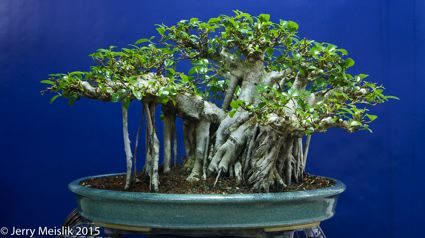
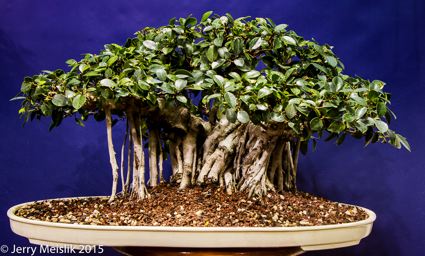
I was gifted this Ficus microcarpa from my good friend David Fukumoto in 2004. It was just accepted into the bonsai collection of the Denver Botanic Garden this July of 2015.
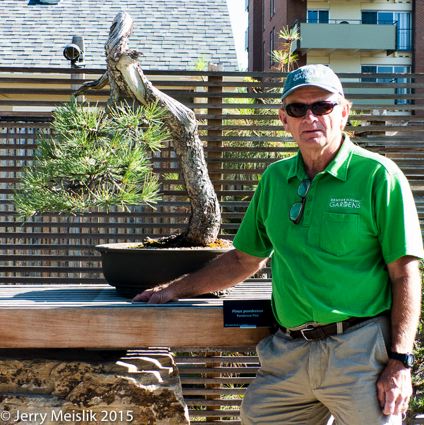
Defoliated to show the branch patternsPartially re-leafed after defoliationIn full leafLarry Jackel, curator of the DBG bonsai collection, and his Ponderosa pine
I am greatly honored to have one of my best trees find a wonderful home for the next phase of its life. A place where it will live and be admired for many years.
To review the history of this fig please refer to:
The definitive reference work on Ficus
for bonsai. The book is a softcover, 8 by 10 inch volume, with 144 color pages, containing detailed information for the beginner as well as the advanced hobbyist.