Author: Richard

  • Moving an aerial root

    Aerial roots are one of the very useful and impressive features of some fig trees. As with other design elements of a bonsai the aerials must augment the overall design scheme.

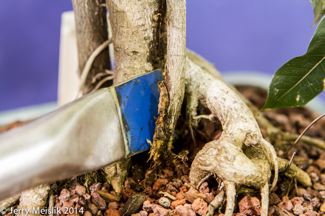
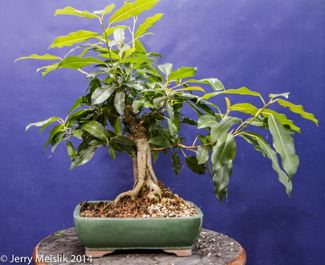
    In this Ficus virens the aerial root crosses across the trunk and in addition it gives the appearance of a reverse taper to the trunk of this tree. It could be removed or a better option is to move it to the other side of the trunk and use it to improve the taper of the trunk.
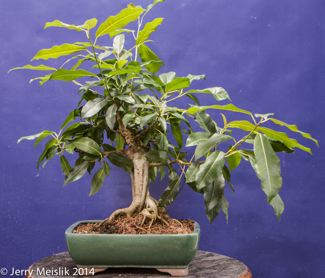
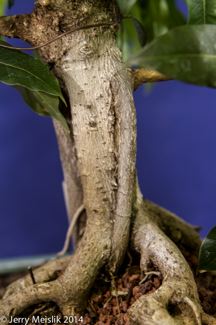
    The aerial crosses the trunk
    The aerial crosses the trunk
    _MG_0011
    Closer view of the crossing aerial
    _MG_0013
    A chisel is used to separate the root from its adherence to the trunk
    _MG_0020
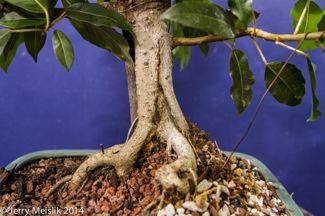
    The aerial is repositioned to the right side of the trunk
    _MG_0021
    Close view showing moss added to the base of the aerial to help promote new hair roots to form

    The moved aerial is wrapped with sphagnum moss and placed into the soil. Within several weeks new hair roots will form on this aerial and make it a permanent fixture of the design.


    The definitive reference work on Ficus
    for bonsai. The book is a softcover, 8 by 10 inch volume, with 144 color pages, containing detailed information for the beginner as well as the advanced hobbyist.
     Click here for more information

  • Ficus cuttings, a great way to get more trees

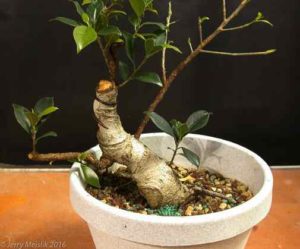
    Over the years I have taken many hundreds of cuttings. Most Ficus can be started easily from cuttings and even large size cuttings can be rooted with success.

    DSCN5149
    Ficus cutting about 8-9 years ago

    This is a Ficus microcarpa cutting taken from one of my very large bonsai.

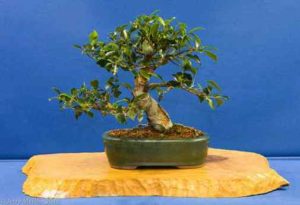
    It was allowed to grow without trimming to recover strength and over time branches were selected to keep, other branches were removed and other branches were grafted into areas needing a branch. The bonsai after 9 years of training. Still not completed but it has come a long way from the start.

    20080221_set3_1044
    Years later the same cutting is beginning to be an attractive bonsai

    Consider rooting your extra cuttings to use for future bonsai.


    The definitive reference work on Ficus
    for bonsai. The book is a softcover, 8 by 10 inch volume, with 144 color pages, containing detailed information for the beginner as well as the advanced hobbyist.
  • Working with bonsai artist Hank Miller

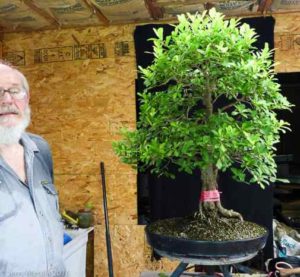
    I had the great pleasure of spending a few days with Hank Miller. He is a bonsai grower, artist and bonsai teacher. Hank grows mainly species in his greenhouse but he loves working with Ficus natalensis and Ficus burtt-davyi. These clones of Ficus were selected by him for strong growth, small leaf size and responding really well to bonsai culture.

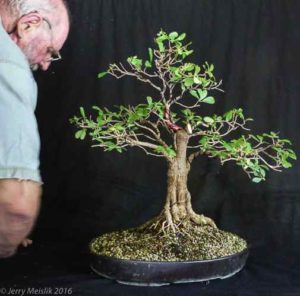
    First, Hank took this fused Ficus natalensis and shortened it back. He felt this was necessary since the middle of the tree had a long straight segment with little or no branching. By shortening the tree he improved its overall flow and design. It will take a year or two for the new apex to mature but it will then be a really wonderful bonsai tree. Hank will root the removed top  as another tree!

    A Ficus natalensis that is about 7 years old, developed from a fusion of many rooted cuttings
    Hank beside Ficus natalensis that is about 7 years old, developed from a fusion of many rooted cuttings
    P1060326
    Top of the bonsai has been cut away
    P1060330
    A new apex has been brought up and will be developed over the next two years to complete the design

    Tree two is another of Hank’s fused Ficus natalensis that is a completed bonsai and requires mainly maintenance work. I think you will agree that it is a lovely and naturalistic deciduous tree design.


    A fused Ficus natalensis that is a completed design and has a naturalistic design
    A fused Ficus natalensis that is a naturalistic design

    To see more of Hank’s work visit his website. He has a number of trees for sale as well as lovely wood bonsai stands. See www.tandamiti.com


  • Demonstration and lecture – Exposed Root Style

    At the recent American Bonsai Society learning symposium in Grand Rapids Michigan I presented a number of programs. One program was a lecture demonstration of the exposed root style bonsai. This happens to be one of my favorite bonsai styles and is little used and discussed.

    In this style the exposed roots are the focal point and the rest of the bonsai is used to enhance the beauty of the exposed root formation. The exposed roots become the natural extension of the trunk.

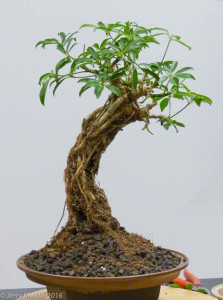
    For this lecture and demonstration I received a 10-12 year old Schefflera arboricola that was grown by David Fukumoto of Fuku-Bonsai. David has devoted most of his career to investigating the vast potential of the Schefflera and the incredible range of styles possible with this material.

    During the demonstration we selected branches and trimmed out over-grown and un-necessary material. The tree was also transplanted to a larger dish after elevating the trunk of the tree about 4 inches. I love how this bonsai looks.

    More people should use Schefflera for indoor bonsai as it tolerates growing in most brightly lit rooms in the home or office.

    The tree after elevating it about 4 inches in a larger pot
    The tree after elevating it about 4 inches in a larger pot
    P1060201
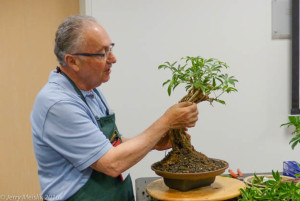
    Discussing the branching and trimming of Schefflera


  • Literati or Bunjin An Unusual Style

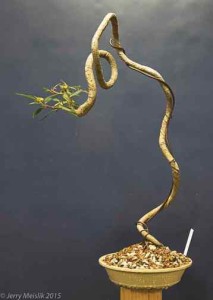
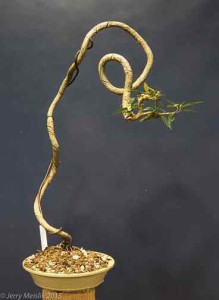
    An uncommon style is the bunjin or literati style. It is a style that emphasizes trunk line above all the other design elements.

    It is not one of the most easily appreciated styles but one that is unique and unusual.

    Here is one of my Ficus ‘Mexicana’ in its first potting.

    Do you like it?

    Ficus in the bunjin style, side one
    Ficus in the bunjin style, side one
    Seuss_23A7188
    Ficus in the bunion style, side two
  • Repotting a large fig

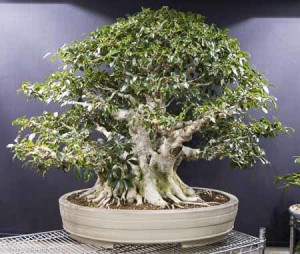
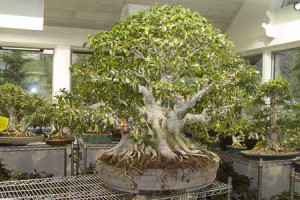
    It has been about three years since this fig was last potted.

    The tree in 2015
    The tree in 2015

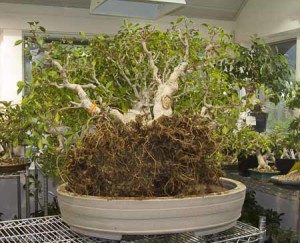
    The soil is somewhat compacted and broken down and therefore needs to be replaced. Since it is a large tree it can’t easily be moved by even two people. So the process involves leaving the tree in the pot, while removing the soil from around the tree.

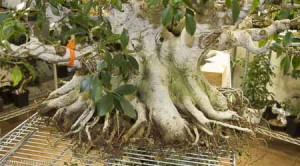
    The old soil has been removed and the tree placed on top of the pot ready for roots to be trimmed back
    The old soil has been removed and the tree placed on top of the pot ready for roots to be trimmed back

    Once most of the soil has been removed the tree can be lifted up and tilted so the roots can be cleaned of any adherent soil and long roots trimmed back

    20160425-_MG_6267
    Tree tilted back to remove old soil and shorten the roots.

    Then the tree is lifted out of the pot and put aside while the pot is cleaned of residual old soil and the pot is placed back up on the shelf.

    Long roots have been shortened back
    Long roots have been shortened back

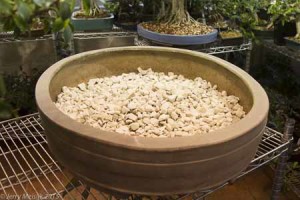
    Then large, coarse inorganic particles are placed into the bottom of the pot.

    Coarse new inorganic media are pot into the bottome of the pot and a mound is left in the center of the pot
    Coarse new inorganic media are pot into the bottom of the pot and a mound is left in the center of the pot

    A central area is hilled up high enough to keep the tree at the proper level and then soil is placed around the tree filling the pot up.

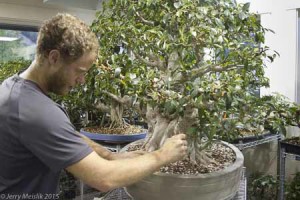
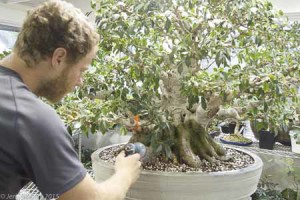
    Once the soil is nearly filling the pot chopsticks are used to settle the soil down into the pot and more soil is added as the chopsticking continues.

    Chopstick used to settle the soil around the roots
    Chopstick used to settle the soil around the roots
    The tree is watered well
    The tree is watered well

    The whole process for this one tree took about 3.5 hours for two people.

  • Ficus ‘Little Ruby’

    Bonsai artist and friend Anthony Webb has a lot of experience growing figs and one in particular that he likes and finds fascinating.
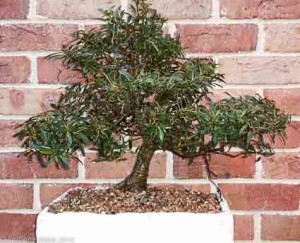
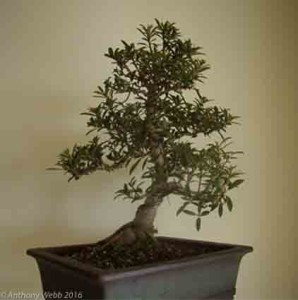
    My plant of Ficus 'Little Ruby'
    My plant of Ficus ‘Little Ruby’
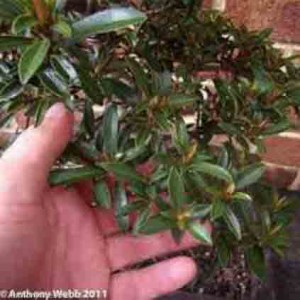
    Same fig 2011
    Same tree, 2011
    20160118-20160118_133653 (2)
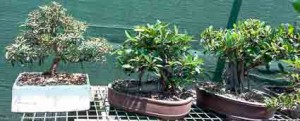
    Little Ruby on the left and normal Ficus rubigionsa, Port Jackson fig in the middle
    20160214-download
    Note the small leaf size in comparison to normal Ficus rubiginosa

    Here is Anthony’s summary about his experience with a Ficus rubiginosa ‘Little Ruby’ over 25 years.

    “Ficus rubiginosa var Little Ruby is native to Australia.
    A cultivar of Ficus rubiginosa (Port Jackson fig) was discovered in a batch of Ficus Rubiginosa seedlings.
    Little Ruby can only be cultivated from cuttings and strikes quite easily.
    Little Ruby is a slower growing fig with dark green narrow leaves.
    My tree is approximately 25 years old, I have learnt that by letting the tree grow out then cutting to the desired shape. The foliage then thickens more than continually trying to force it back by cutting & pinching, as per a lot of other Figs.
    Generally, I wire the trunk & primary branches to shape , but leave branch-lets & secondaries unwired as I find these areas brittle. By using my method of growing out, then trimming back I have had more success in developing. As my tree establishes more roots I will put into a bonsai pot.
    I find it a fascinating tree but for me patience is needed.
    Cheers Anthony”
    For further information on Ficus rubiginosa click here.
  • Identifying a fig’s proper name

    One of the real difficulties that I deal with every day is how to identify a fig in someone’s collection.

    Simply put this is frequently a very difficult task. There are many plant characteristics that botanists use to ID a plant. One of the really important characteristics would be  the syconia or figs of that plant. The problem is that many of our bonsai figs rarely if ever have syconia.

    One factor that is often mentioned is the color of the petiole as a plant identifying feature. In my experience the color of the petiole can vary greatly in seedlings of the same species. In fact the color of the petiole can vary even on the same plant.

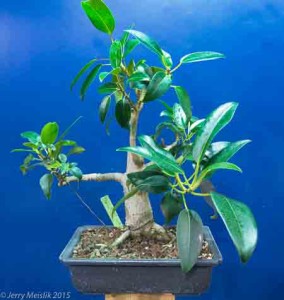
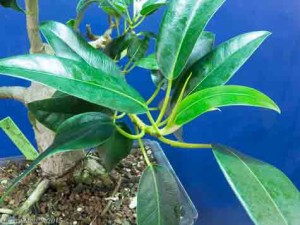
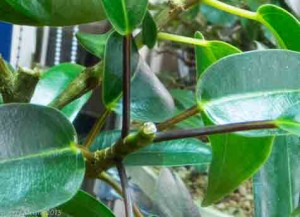
    In the pictures you can see one plant of Ficus macrophylla. The close ups reveal a normal yellow/green petiole on some of the leaves and a red petiole on other leaves of the same plant. Conclusion is that the leaf petiole color is not a reliable chracteristic to ID your figs.

    Ficus macrophylla plant in training as a bonsai
    Ficus macrophylla plant in training as a bonsai
    20160126-P1040199
    Yellow petioles on this plant
    20160126-P1040201
    On another part of this same plant the petioles are red


    The definitive reference work on Ficus
    for bonsai. The book is a softcover, 8 by 10 inch volume, with 144 color pages, containing detailed information for the beginner as well as the advanced hobbyist.
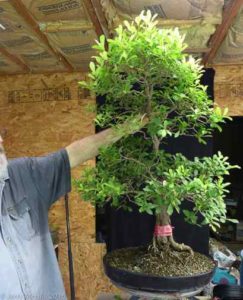
  • Ficus ‘Green Island’, cultivar names

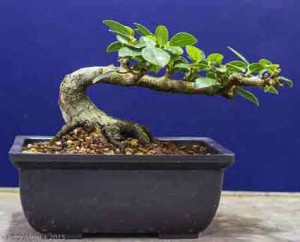
    Ficus ‘Green Island’ is one of the cultivars of Ficus microcarpa. Its main distinguishing characteristics are thick, rubbery leaves that are nearly round. This round leaf character is not unique to ‘Green Island’ but can be found in seedling Ficus microcarpa.

    I have one seedling with very round leaves that is not ‘Green Island’ since it is not grown from cuttings of ‘Green Island’ but is genetically distinct as it is seed grown.

    One can only call a plant a varietal name if the parent from which the cutting is obtained is the specific variety.

    Ficus microcarpa 'Green Island' from a cutting from a mother plant that is 'Green Island'
    Ficus microcarpa ‘Green Island’ – a cutting from a mother plant that is ‘Green Island’
    20140423-_MG_9474-2
    Seedling that has almost round leaves that should not be called ‘Green Island’ as it is genetically distinct. I call it Ficus microcarpa ‘Dwarf Blue’
  • Ficus racemosa an interesting fig species

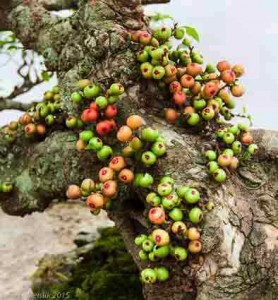
    Ficus racemosa is an interesting fig in that it grows its figs/syconia on the trunk or from heavy branches. This form of flowering is called cauliflory.

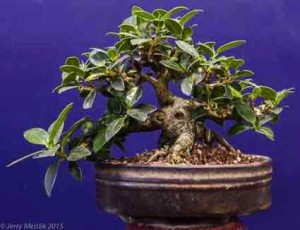
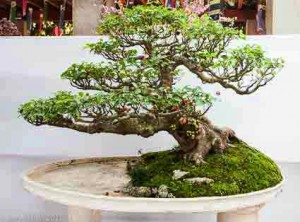
    Ficus racemosa showing figs on the trunk and branches
    Ficus racemosa showing figs on the trunk and branches
    20150605-_MG_5400
    Large red figs on the trunk