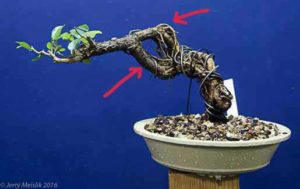
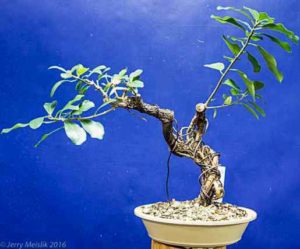
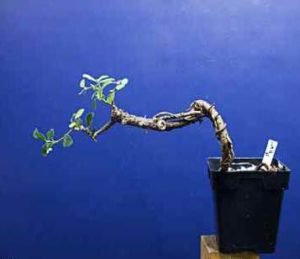
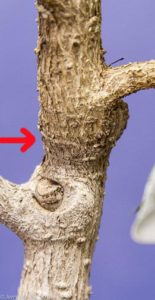
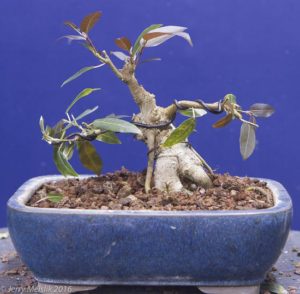
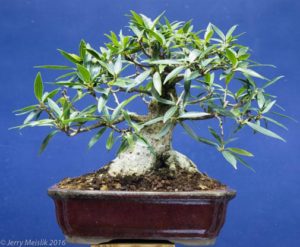
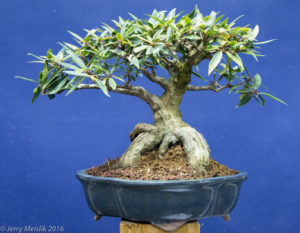
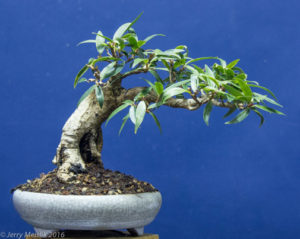
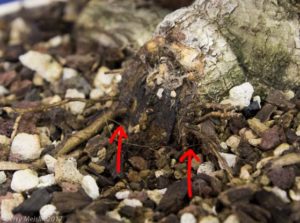
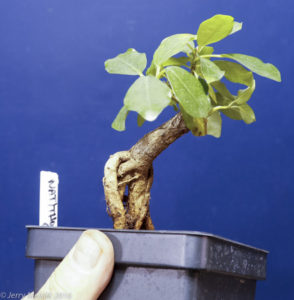
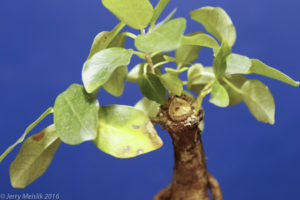
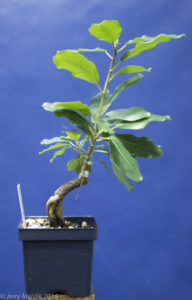
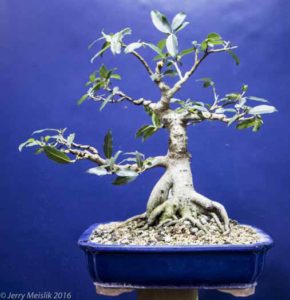
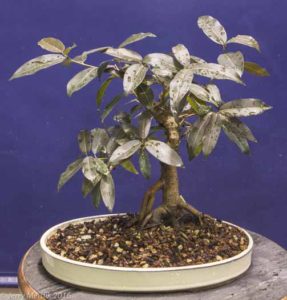
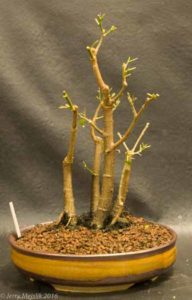
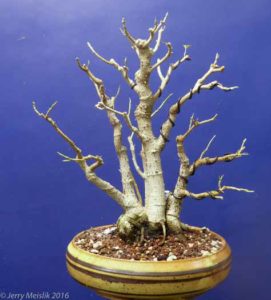
This is a young rooted cutting of Ficus natalensis but the two roots as indicated did not look right to my eyes. So I split the tree and allowed it to sprout back. I like the two new pieces and with more growth I think each may work out to be a reasonable bonsai tree.
Ficus natalensis, rooted cutting, with arrows showing the roots that I did not likeThe small root on the right sprouted outThe small root sprout has been potted up and will be allowed to grow to develop an apexThe larger piece will need more development but I like it better now
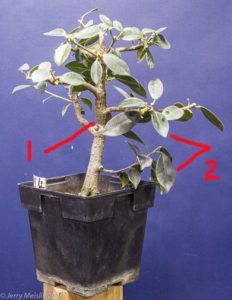
Grafting is a very useful way to improve a fig. It can add branches, new roots or thicken trunks. One factor to keep in mind is to graft identical parts together. Simply use material to graft, the scion, and the stock that are genetically identical. If this is not done the bark and foliage will be a mis-match and not suitable for bonsai.
The graft point is at 1 and the 2 shows that the foliage of the graft and the stock are not the same. Both are Ficus microcarpa but not genetically identical.Close up of the graft point, 1, shows the mis-match in the bark color and texture
Aerial roots grow faster than the trunk. A fact to keep in mind as you design and change your bonsai over time. I am not sure why the aerials grow faster but it seems that they do.
2016, aerials are much larger2012, aerials are pretty small at the start
There are several ways to thicken the trunk of a bonsai. One way is to take aerials that are near the trunk and pull them over to touch the trunk and hold them tightly in place. Over time the aerials will fuse to the trunk enlarging it, as well as creating improved surface rootage/nebari.
Three or four years ago the same Ficus has small aerial on either side of the trunk. They are pulled close to the trunk and held in position
Aerials are now fused to the base, increase the taper and thickeness of the lower trunk
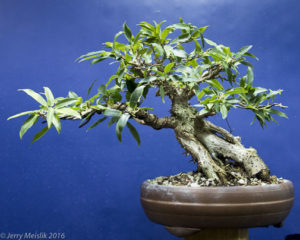
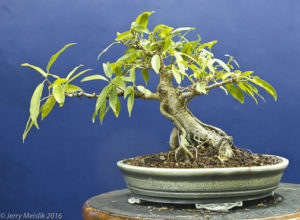
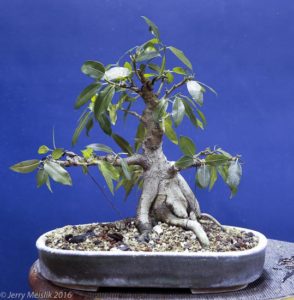
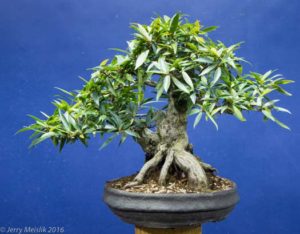
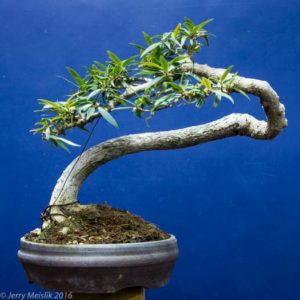
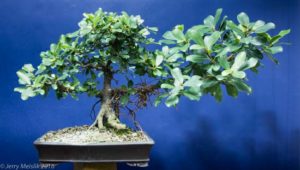
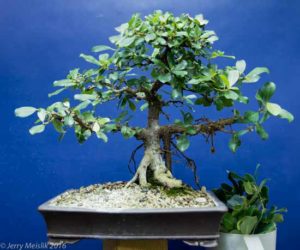
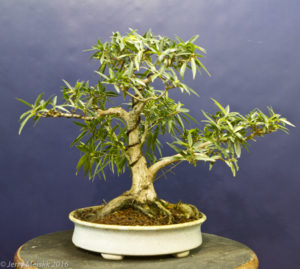
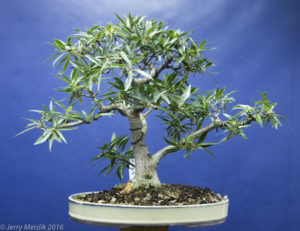
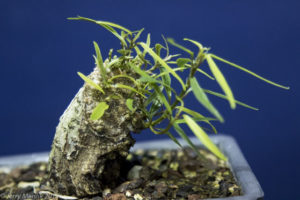
Willow leaf fig is a terrific species to use for smaller bonsai since its leaves are already small and will be in good proportion for smaller bonsai.
An assortment of Willow Leaf figs is shown that are all grown from cuttings and are less than 10″.
The definitive reference work on Ficus
for bonsai. The book is a softcover, 8 by 10 inch volume, with 144 color pages, containing detailed information for the beginner as well as the advanced hobbyist.
Slave branches are used to thicken a bonsai trunk or even branch. By allowing wild and untrimmed growth of these branches the trunk or branch can be thickened.
Once the thickening is done the slave branch can be removed or trimmed back.
Wild and untrimmed growth to thicken this branch on a Ficus natalensis/thonningii complex bonsaiThe branch has been shortened back once it has the proper thickness but needs secondary and tertiary branches to be developed
The branch thus thickened, as in this case, now has a proper thickness but will need more work to ramify it and develop secondary and tertiary branches. This can be done with repeated nipping out of buds and defoliation techniques.
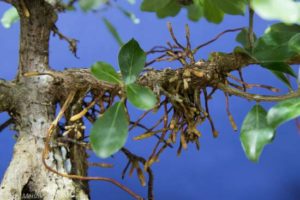
Aerial roots are kept on this branch as they speed branch thickening
In dealing with a fig that has too heavy a root there are several ways to handle the situation. One, is to simply use soil and moss to partially or completely cover the thick root.
Another solution is to cut the large root completely off. After removing the root seal the cut with cut paste and cover lightly with some soil or sphagnum moss. Usually the cut root will sprout and replace the heavy part with a new and thinner root in much better scale than the original. Cutting off one large root on a healthy tree should not prove to be harmful to the bonsai tree.
Heavy root on the left is not in scale with the rest of the tree
Heavy root on the left has been totally removed and smeared with cut pasteThe removed portion of the root is sprouting and will become another bonsaiThe cut end of the root on the tree shows new finer roots taking over and once a bit thicker will be in good scale to the size of the bonsai
Yet other ways to handle the heavy root is to split the root or cut the root in half lenghtwise.
All of these will result in a root that is proper scale to the trunk and design of the tree.
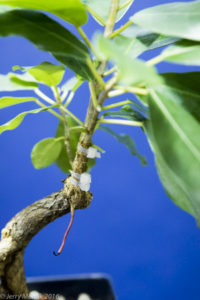
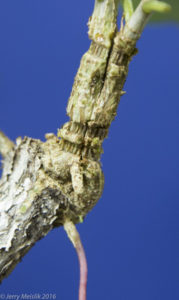
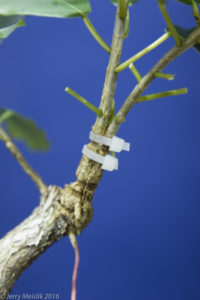
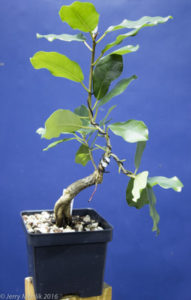
This is a young plant grown from a root cutting of a Ficus natalensis. The root cutting sprouted three branches.
To develop a new apex and create a better transition to the new apex, two of the sprouts were pulled together with electrical ties. A month or two passed and the ties were removed. The lower part of the fusion appears to be nicely grown together but the upper portion is not fused. So several new electrical ties were placed in areas adjacent to the old ties.
Root cutting of Ficus natalensisSide view shows three sprouts have grown from the root cuttingTo develop a thicker transition to the trunk two of the sprouts were tied together with electrical tiesAfter a month or two the ties appear to have workedThe ties were removed and the upper part of the fusion was not together. Some mild scars from the ties will be present for about 6 months. With growth they will disappear.Two new ties were placed adjacent to the old ones and growth will be allowed to speed the fusion more completelySome basic wiring was done to give the young bonsai a bit of shape
The definitive reference work on Ficus
for bonsai. The book is a softcover, 8 by 10 inch volume, with 144 color pages, containing detailed information for the beginner as well as the advanced hobbyist.
Aerial roots are one of the most unique and wonderful features of figs. Aerial roots start out as small fine filaments from the trunk or branches and grow down to the soil. Once rooted into the soil they thicken and can become as thick or thicker than the trunk or branch from which they originated.
Growth of the aerial is faster than growth of the trunk. Designs utilizing aerials may need to be adjusted over time to compensate for the aerials growth.
Ficus virens with aerial on the left side of the trunk, 2016The same aerial on the left side of the trunk, 2013.