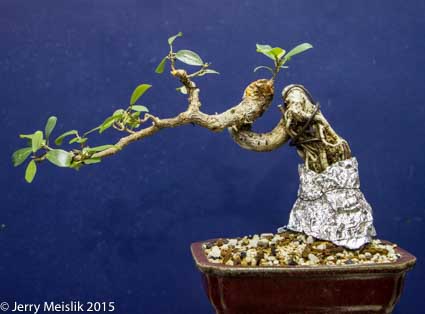
Author: Richard

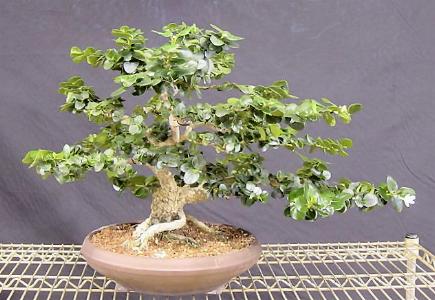
  • Carissa grandiflora – Natal Plum

    Carissa grandiflora – Natal Plum

    This plant started its life many years ago as a cherished potted shrub of friends. I admired the
    tree for many years, and they ultimately tired of my asking to buy it and one day they brought the tree to my home and gave it to me as a gift.

    At that time it stood six or seven feet tall and 3-4 feet wide. It was an unruly mess, but it had a nice basal trunk. I proceeded to shorten the tree to only two stubs about 6 inches tall, and threw away 3 large waste bags of branches and foliage. The tree responded very well to the aggressive trimming and produced new foliage. From these "breaks" a new apex and structure were created.

    The Carissa has lovely white star-like flowers which are very fragrant. It has never set fruit on these flowers. The fruit is claimed to be edible. Click here to see the beautiful flower. Sorry you can't get its fragrance.

    There are nasty thorns contained inside the foliage but I trim these off as they appear. The plant prefers to dry well between waterings and resents having "wet feet". This tree is 17 inches tall and has a 2.5 inch trunk diameter.

    All Rights Reserved © 2002 Jerry Meislik
    Back to Bonsai Gallery

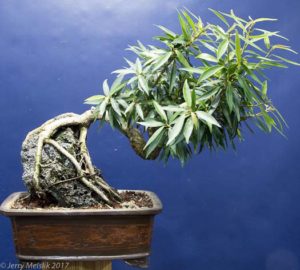
  • Ficus salicaria, Willow Leaf fig in root-over-rock style

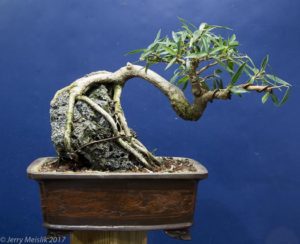
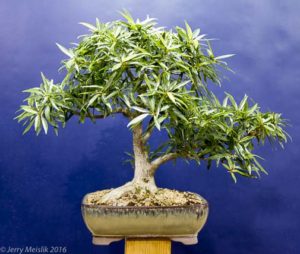
    A Willow Leaf fig developed from a root cutting and placed on a rock. I allow it to grow wildly to help the roots grab hold of the rock and periodically I trim it back to keep the canopy shape in proper proportions.

    Overgrown to allow the roots to adhere properly to the stone

    Canoy trimmed back to keep the canopy under control and properly shaped

    .


  • Dealing with a large root

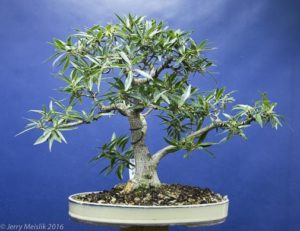
    Large roots on a bonsai design can ruin the visual flow of the bonsai. With healthy figs the heavy root can be removed totally. The removed root of some fig species can sprout and produce another tree with which to create yet another bonsai.


    _mg_1859
    Ficus salicaria, Willow Leaf fig, with a root on the left that is too large

    _23a3221
    The tree without the root looks much better

    _23a3996
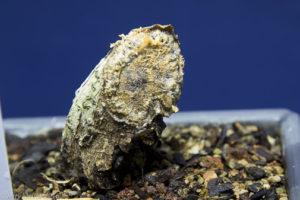
    The removed root is planted in some bonsai soil and kept just moist

    _23a3996-2
    A close up of the root showing the new sprout emerging at the 4-5 clock hour position

  • Naming Figs

    Figs can show many variations when grown from seed. Seedlings are never identical to the parent tree.  This variability helps the fig adapt to different conditions in its environment but often complicates or makes a firm identification of a fig species a real guessing game. Once the fig has syconia/figs the naming is often a much easier process.

    For example Ficus microcarpa, the Chinese Banyan, is one of the most popular figs to use for bonsai and it is also one of the most variable. I am going to list some examples of the variation possible in just this species but there are other fig species that are also just as variable.

    Leaf shape varying from almost round to long and tapered

    Leaf size varying from fingernail to almost palm size

    Leaf color from yellowish green to dark green

    Leaf thickness from paper thin to thick and rubbery

    Leaf glossy or shiny varying from dull to very waxy

    Petiole color from yellow, to green, to red

    Trunk and bark color varying from dark grey, brown,  to very white with many or no spots of white

    Clearly identifying a specific plant as a distinct species of fig can be complicated.

    A seedling of a named cultivar, say Ficus microcarpa ‘Green Island’ should not be called ‘Green Island’. Only a cutting(vegetative propagation) of the mother tree will be genetically identical and properly called ‘Green Island’.  As an example, I have seed grown Ficus microcarpa that look very similar to ‘Green Island’ but the tree that they come from is not ‘Green Island’ and even if it was the seedlings should just be called Ficus microcarpa x’Green Island’. The x indicating that it is a cross of Green Island and something else. But if I take a cutting form a real ‘Green Island’ than I can properly call it Ficus microcarpa ‘Green Island’.

  • How to get a thick trunk and tapered bonsai

    Many bonsai growers love thick trunk and quickly tapering bonsai. They often write and us for a technique on how to create such a design. Unfortunately, there are no quick ways to obtain a heavy and tapered trunk.
    One, is to search through hundreds of pre-bonsai to select several that 
    have the potential to become a good tapered trunk bonsai. Most pre-bonsai material doesnot have the potential for such styling.
    Two, reduction or chops are critical to developing the taper that is desired. Basicallya chop is made at a point where transitioning to a branch allows the trunk to taper. Sometimes several reductions are necessary over a period of years to achievethe desired taper. Reductions if done on the back of the tree make the reduction cut less obvious. An excellent piece of pre-bonsai material may allow 3 reduction cuts to be done at one step thus reducing the number of years needed to create a good bonsai design. 
    Three, grafting of aerials to the trunk  
    Four, a proper transition to a believable apex would need to exist on the tree as 
    growing a totally new one would take some years.
    So, spending a lot of time in dealers who have likely candidates would allow one to find candidates that would make great starting points
    would certainly help. Or finding one that has been pre-bonsaied by a 
    dealer would put you on the right track.
  • Taper for your bonsai

    One aspect that is critical to a bonsai’s design is the proper taper of the trunk and secondarily the branches should mirror the taper as determined by the trunk and the base of the tree.

    Not all bonsai need dramatic taper. Some bonsai are wonderfully designed with a long slim trunk that has little or no taper. Bunjin or literati designs often show little taper and yet they can be spectacular bonsai designs.

    The most critical factor is the consisency of the pattern in the trunk. Designs that do not seem to work well are ones that mix little taper with lots of taper. Once the taper is set by the lower trunk the rest of the tree’s design should follow.

    _MG_3254
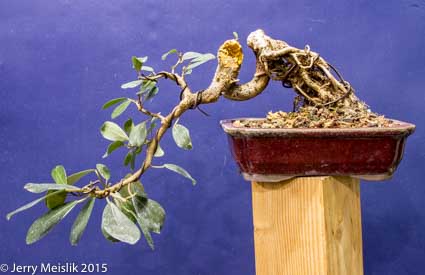
    Semi-cascade exposed root style with an overly long and cascade end that is not tapered

    _MG_5886 copy
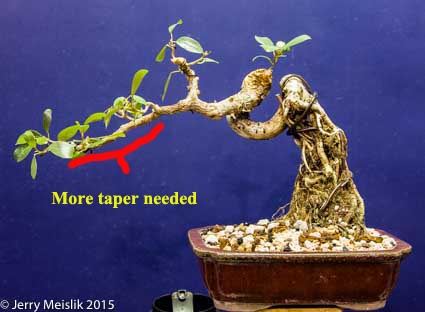
    The terminal has been shortened and the taper is beter but still the taper feels not to be quite enough

    _MG_8013 copy
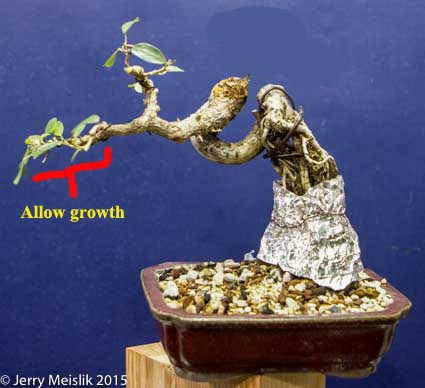
    The terminal has been shortened more. Taper at this point seems a bit too abrupt but lengthening the tip will cure this problem


  • Acer rubrum – Red Maple

    Acer rubrum – Red Maple

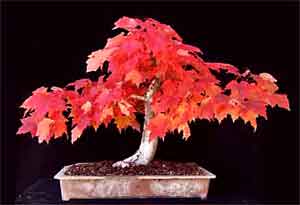
    Acer rubrum is a tree that is found growing from Canada to Florida. The material is used for bonsai relatively infrequently due its large leaves and long internodes.

    This tree was collected in 1991 in northern Michigan and was reduced from a 12 foot tall tree to about 15". No branches were usable and the tree was just a stump, surface roots and a small root ball.

    In a container, it grows slowly and has been reluctant to ramify. It has been defoliated several times and this has produced smaller leaves, back-budding and more ramification.

    My main reason for growing it is the spectacular fall color. The picture shows the tree in its splendor. Unfortunately, it only develops good color every 3 or 4 years.

    The tree is 22 inches tall and 4 inches in trunk diameter.

    All Rights Reserved © 2004 Jerry Meislik

    Back to Bonsai Gallery

  • Schefflera arboricola – Dwarf Schefflera

    Schefflera arboricola – Dwarf Schefflera

    Schefflera arboricola – Dwarf Schefflera

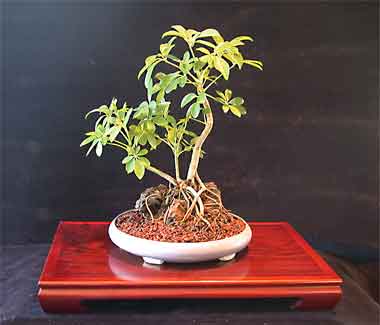
    This Dwarf Schefflera was purchased as three seedlings. They were planted over the stone and allowed to root over and around the rock.

    After growing for about one year, the grouping was placed into a shallower pot and the roots were exposed.

    Root over rock designs are easy to create.

    The tree is 12 inches tall from the pot's rim. The plants are now only three years old.

    All Rights Reserved © 2004 Jerry Meislik

    Back to Bonsai Gallery

  • Pinus flexilis – Limber Pine – View 2

    Pinus flexilis – Limber Pine – View 2

    The Limber Pine, Pinus flexilis, is a pine native to the Northwest USA. It is a 5-needle pine easily misidentified in a bonsai collection as Pinus parviflora, the Japanese 5 needle pine.

    The Limber pine grows at high elevations on the eastern slope of the Rocky Mountains. It is adapted to intense solar radiation, high winds and dryness. There are stands of these trees containing specimens many thousands of years old.

    Used as bonsai they grow slowly but make beautiful trees. As with all pines grow them in an open granular soil mix and keep the roots from staying wet. Otherwise there seems to be no problems with this pine.

    The needles are blue green and not stiff or spiky to the touch. The common name of Limber pine tells you that the branches are very flexible yet they accept wiring very well.

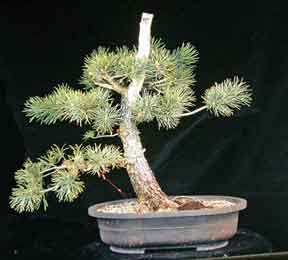
    The tree in the picture is one that was purchased from a nursery in 1985 and estimated to be about 28-30 years old. The original top was sawed off and a dead wood apex was created to to shorten the 7 foot tree and to create the illusion of age.

    At higher elevations a one inch trunk can signify one hundred years of age! As with all bonsai use caution in evaluating age of a tree by its appearance. A very similar species that grows mainly on the western slope of the Rockies is the Whitebark pine, Pinus albicaulis.

    Click here to see the Whitebark pine and its fight with white pine blister rust.

    The plant is 24 inches tall with a main trunk diameter of 3.5 inches.

    To see other Limber pine bonsai click here.

    All Rights Reserved © 2005 Jerry Meislik

    Back to Bonsai Gallery

  • Pinus flexilis – Limber Pine – View 1

    Pinus flexilis – Limber Pine – View 1

    The Limber Pine, Pinus flexilis, is a pine native to the Northwest USA. It is a 5-needle pine easily misidentified in a bonsai collection as Pinus parviflora, the Japanese 5 needle pine.

    The Limber pine grows at high elevations on the eastern slope of the Rocky Mountains. It is adapted to intense solar radiation, high winds and dryness. There are stands of these trees containing specimens many thousands of years old.

    Used as bonsai they grow slowly but make beautiful trees. As with all pines grow them in an open granular soil mix and keep the roots from staying wet. Otherwise there seems to be no problems with this pine.

    The needles are blue green and not stiff or spiky to the touch. The common name of Limber pine tells you that the branches are very flexible yet they accept wiring very well.

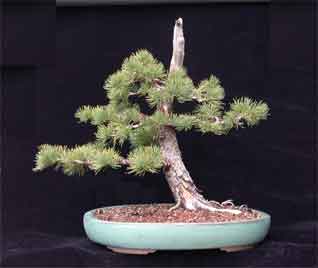
    The tree in the picture is one that was purchased from a nursery in 1985 and estimated to be about 28-30 years old. The original top was sawed off and a dead wood apex was created to to shorten the 7 foot tree and to create the illusion of age.

    At higher elevations a one inch trunk can signify one hundred years of age! As with all bonsai use caution in evaluating age of a tree by its appearance. A very similar species that grows mainly on the western slope of the Rockies is the Whitebark pine, Pinus albicaulis.

    Click here to see the Whitebark pine and its fight with white pine blister rust.

    The plant is 24 inches tall with a main trunk diameter of 3.5 inches.

    To see other Limber pine bonsai click here.

    All Rights Reserved © 2005 Jerry Meislik

    Back to Bonsai Gallery