Limber pine, #4 was purchased in a landscape nursery. It height was reduced by two feet. It has been in training for 16 years and it is 24 inches in height.
All Rights Reserved © 2004 Jerry Meislik
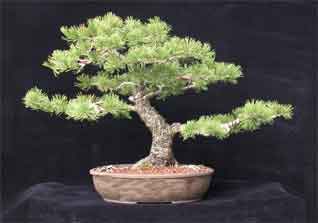
Limber pine, #4 was purchased in a landscape nursery. It height was reduced by two feet. It has been in training for 16 years and it is 24 inches in height.
All Rights Reserved © 2004 Jerry Meislik
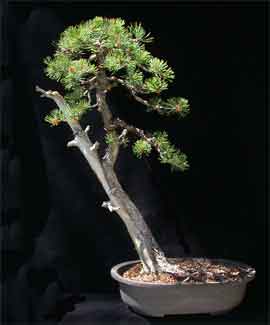
The Limber pine, #3, was collected in Colorado and has been in training for 13 years. It is 40 inches in height. When collected, the whole tree was infested with borers and had to be drastically restyled.
All Rights Reserved © 2004 Jerry Meislik
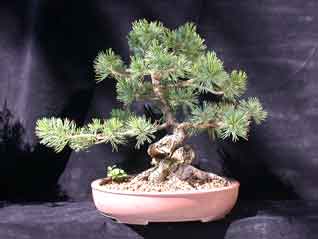
Limber Pine, #2, was collected in Colorado and has been in bonsai training for 16 years. Height is 26 inches.
All Rights Reserved © 2004 Jerry Meislik
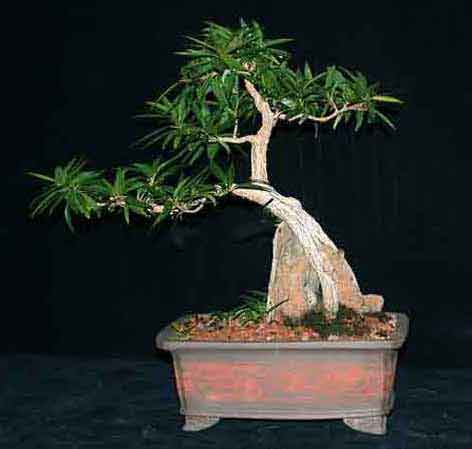
This Ficus salicaria was started as a root cutting that was planted over this stone about two years prior to the photo. The tree is quite young and will take years to gain some maturity. Even so, it is an attractive bonsai that will only improve over the years. Root over rock styles such as this make very attractive bonsai even with immature material. The tree is 13 inches tall from the pot's rim.
All Rights Reserved © 2008 Jerry Meislik
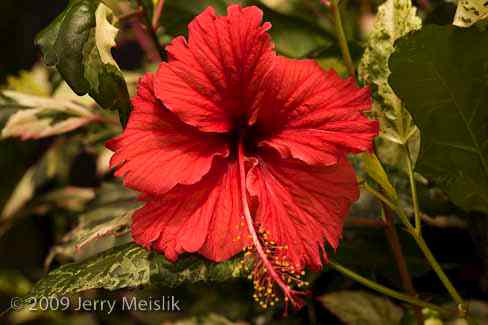
This plant was started from a small cutting over 20 years ago. It grows quickly and needs trimming several times each year. Hibiscus roots fill the container and it must be repotted yearly.
The plant begins to fail if not repotted regularly and branches can die off.
The red pot was selected to complement the leaves which have three colors; white, red and green.
The flowers are a shocking pink and very large. In bloom the tree looks quite out of scale.
The tree is 13 inches tall and the trunk diamter is 1.25 inches.
There are many Hibiscus that can be used for bonsai. Hibiscus tiliaceus is another Hibiscus that grows near the beach in Taiwan and is used extensively for bonsai. It has large leaves that must be kept restrained to be in scale. See this article on Master Min-Shuan Lo.
All Rights Reserved © 2009 Jerry Meislik
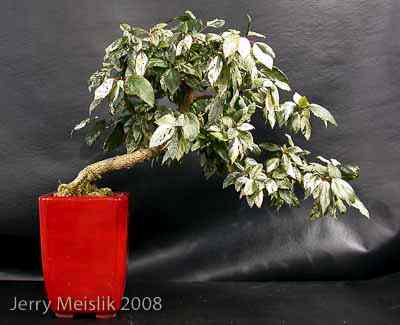
This plant was started from a small cutting over 20 years ago. It grows quickly and needs trimming several times each year. Hibiscus roots fill the container and it must be repotted yearly.
The plant begins to fail if not repotted regularly and branches can die off.
The red pot was selected to complement the leaves which have three colors; white, red and green.
The flowers are a shocking pink and very large. In bloom the tree looks quite out of scale.
The tree is 13 inches tall and the trunk diamter is 1.25 inches.
There are many Hibiscus that can be used for bonsai. Hibiscus tiliaceus is another Hibiscus that grows near the beach in Taiwan and is used extensively for bonsai. It has large leaves that must be kept restrained to be in scale. See this article on Master Min-Shuan Lo.
All Rights Reserved © 2009 Jerry Meislik
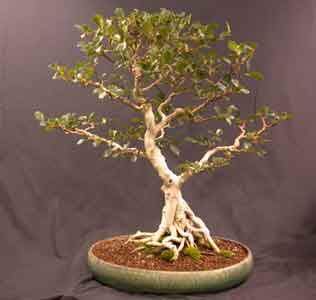
This Ficus microcarpa was obtained in 1984 from David Fukumoto of Fuku Bonsai, Hawaii . The tree's progress was slow in its first few years due to my inexperience with the material, especially a reluctance to trim it hard and often. Once I learned this plant's requirements, the tree's progress accelerated.
Over the next few years I will increase its ramification and density by leaf pruning it yearly. Perhaps some aerial roots will be developed to give it a banyan configuration.
Ficus microcarpa is one of the best of the figs for indoor and tropical bonsai. It is tough, durable and responds well, once its simple cultural requirements are understood.
Several grafts have been placed onto areas of the tree which have proved resistant to developing new foliage. Approach and free grafts have been easy and successful.
The tree is 29 inches tall and 4.5 inches in diameter.
All Rights Reserved © 2004 Jerry Meislik
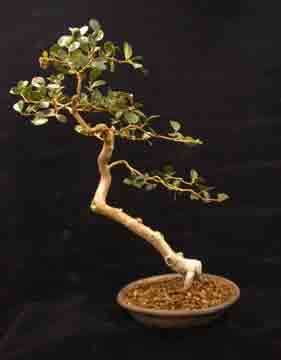
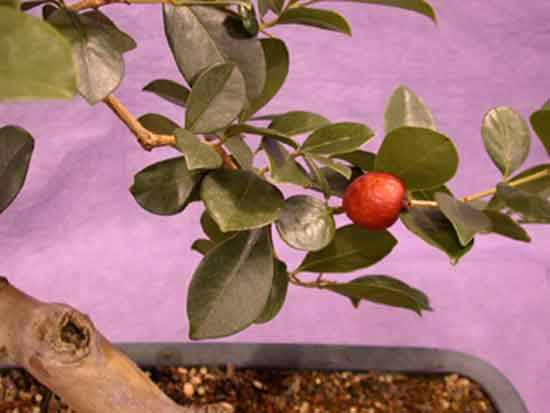
This strawberry Guava has lived indoors under lights for the last 11 years and has flowered and fruited only twice in all these years. The fruit is 1.5 inches in diameter and brick red when ripe. See fruit by clicking here. It is a delicious treat that actually tastes like a strawberry. It fruited recently and had 15 fruits. Seeds have been planted for the next generation of bonsai.
Its most interesting feature is the exfoliating multi-colored bark which sheds in irregular patches at varying intervals. The tree also heals over cuts with a nice flat scar.
This tree requires lots of water so keeping the soil moist in a shallow container is a bit of a challenge.
The Guava is very happy growing under lights and due to its thick leaves it tolerates indoor dryness quite well. It has no insect or other problems.
There are many other species of Guava that can be used for bonsai but many have larger thinner leaves.
The tree is 27 inches tall and has a trunk of 2.5 inches.
All Rights Reserved © 2004 Jerry Meislik
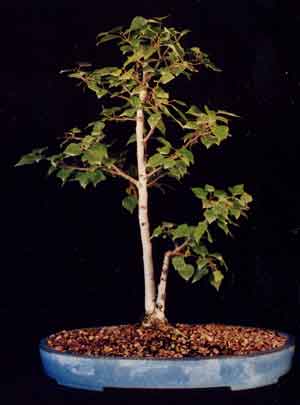
This European white birch tree was collected from the wild and shortened back.
It has lovely white bark and is a vigorous grower. It is susceptible to birch leaf miner and needs to be sprayed to prevent this unsightly leaf damage.
Otherwise the tree is vigorous and needs no special care.
It will sucker from the base and these sprouts need to be removed otherwise the tree will quickly become a sprout style bonsai.
The tree is 20 inches tall and is now in a friends collection.
All Rights Reserved © 2004 Jerry Meislik
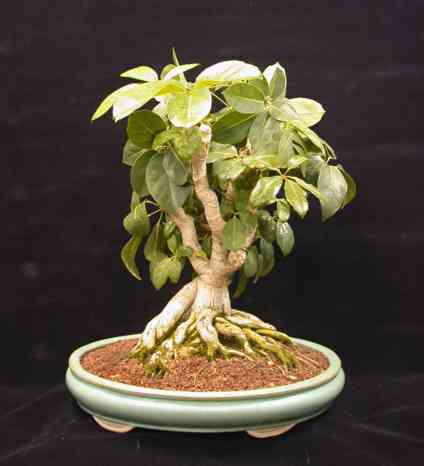
This full sized Schefflera was purchased as two seedlings in 1990 for one dollar! The trees were planted on a stone which is now buried under the massive root base of this tree. It has grown under lights for all these years, and has event spent a year or two under fluorescent lights in an office and tolerated these low light conditions without complaint.
The plant tolerates very dry air due to its thick, almost succulent leaves. Branching is encouraged by hacking the plant back to bare stems on a yearly basis. This induces back budding and some branching. The huge leaves reduce some with this severe back trimming, but continuing growth ultimately results in very large leaves. It will never be ramified enough to be considered a detailed bonsai, but considering everything it is remarkable the condtions that it will tolerate.
Soil must be allowed to dry a bit between waterings since wet roots will cause rot and kill the tree.
Schefflera forms aerial roots under moist conditions. The large root on the left side of the trunk started as a fine hair root and eventually set itself into the ground and thickened so much that it now looks almost like part of the trunk.
Branch ramification is my goal for the next few years.
The tree is 18 inches tall and with a 3 inch trunk diameter.
All Rights Reserved © 2006 Jerry Meislik