Author: Richard

  • Euonymus alatus – Winged Euonymus

    Euonymus alatus – Winged Euonymus

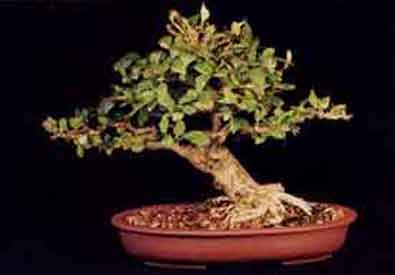
    This Euonymus alatus was salvaged from our yard where it was a neglected landscape shrub.

    The tree responded very nicely to pot culture and developed well ramified branches in several years. It even blooms and sets fruit most years. The fruit is a hanging orange berry.

    It must be repotted yearly as the fine hair roots will fill all the spaces in the soil and compact it severely.

    The plant has had no insect pests and is easy to wire on new wood. Older wood is quite stiff and risky to wire.

    The picture was taken in 1995 and the tree was sold to a friend in Montana who now cares for it.

    The tree is 13 inches tall and 2 inches in trunk diameter.

    All Rights Reserved © 2004 Jerry Meislik

    Back to Bonsai Gallery
  • Malus – Common Apple

    Malus – Common Apple

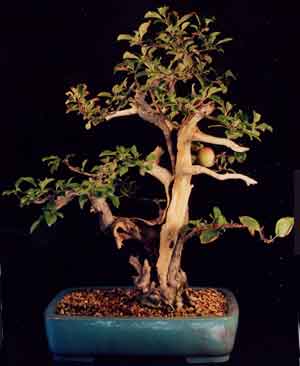
    This apple was collected from a friend's pasture where it had been deer and cattle grazed for over 40 years. Much of the tree was dead but a living strip on its left side provided enough vascular supply to keep the foliage happy.

    Many apple trees were collected from the same pasture during the summer and still the survival rate was extremely high. Apples and crab apples are very tough trees and make great bonsai.

    The tree is easy to care for but must be sprayed regularly to keep borers, aphids and fungal diseases under control. About 4 years after collection it bloomed and a small apple can be seen on the right side of the tree. After this it bloomed every year.

    Repotting is needed every one to two years.

    The tree is 22 inches tall and is now in a friend's collection.

    All Rights Reserved © 2004 Jerry Meislik

    Back to Bonsai Gallery
  • Ficus benjamina – The Weeping Fig

    Ficus benjamina – The Weeping Fig


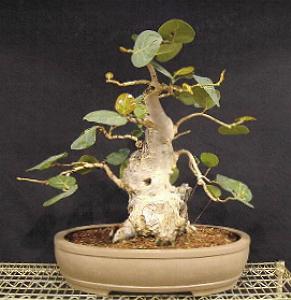
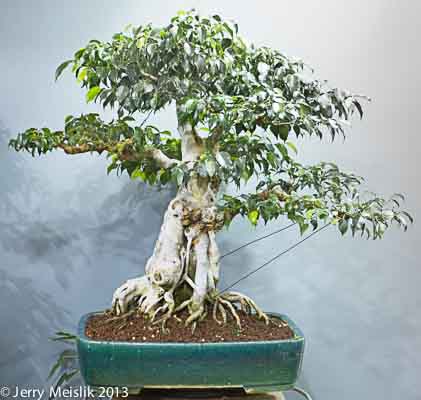
    When purchased in 1990 this Ficus benjamina was a ten foot tall, potted indoor landscape tree. It was used for years as a rental tree for parties. I aquired the tree because of its lovely base.

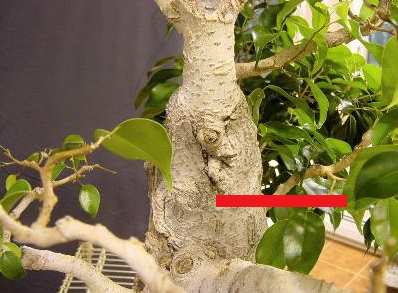
    Prior to shortening the tree down to 23 inches, I air-layered the top 8 feet of the tree and used the top as a houseplant. During the layering process the base sprouted new branches near the bottom but did not sprout any new foliage at the cut point from which hopefully would sprout the new apex. After 90 days, the air layer was severed. However the bottom still would not sprout foliage at the top of the now decapitated tree. Before too much more time elapsed I brought two young branches up from lower down on the tree and grafted them into the top of the tree (1991). Both grafts took and were on their own in 90-100 days. No one realizes that the top of this tree originated from these two grafts. Click here to view one graft point in more detail. The area above the red bar is the graft. It now is the whole of the tree's apex.

    The original reduction cut on the trunk was shaped into a "V" shape to make it look more natural.

    Ficus benjamina is one of the most common bonsai figs in the United States but it is somewhat difficult to handle due to its reluctance to bud back on severely cut limbs and trunks. When cutting back, be sure to leave lots of spare room since branches cut back beyond their foliage point may just die and not resprout. Severely cut back trunks will usually sprout back, but new sprouts may be erratic and not at the desired location. Regrowth is naturally much stronger for trees grown in the tropics.

    The lowest branch on the right needs to be thickened, and it will not be cut back or trimmed until the branch thickens. At that time the branch will be wired back to its proper postion and trimmed.

    The tree is now 37 inches tall and 8.5 inches in diameter.

    All Rights Reserved © 2013 Jerry Meislik

    Back to Bonsai Gallery
  • Buttonwood – Conocarpus erectus

    Buttonwood – Conocarpus erectus

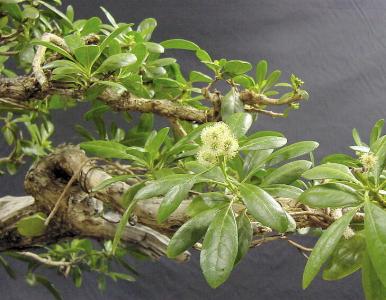
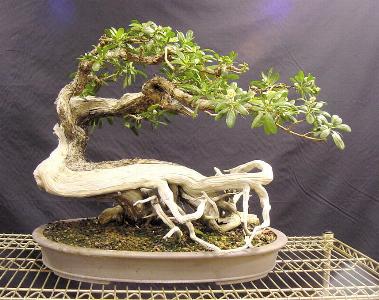
    This Buttonwood tree, Conocarpus erectus, was purchased in 1992 but originally was collected in Florida. It is 22 inches tall and with a main tunk diameter of 4.5 inches.

    It has been very happily growing in my greenhouse, and tolerates very high heat, up to 120 Fahrenheit, which occasionally occurs when my greenhouse ventilation quits.

    The flowers are small plain yellow little puff-balls. Click here to view the flowers. So far the tree has not set seed since there is no pollinator in the greenhouse.

    All Rights Reserved © 2002 Jerry Meislik

    Back to Bonsai Gallery
  • Bougainvillea glabra – Bougainvillea

    Bougainvillea glabra – Bougainvillea

    This Bougainvillea was purchased as pre-bonsai stock in 1989.

    The tree took some years to stabilize under my growing conditions, and for many years never really showed good vigor. In the last few years I have increased its light exposure with metal halide lights and kept the tree a bit drier and potted it in an airy, loose soil mix. This has resulted in much better growth and also in copious flowering lasting months at a time.

    The most critical factors for keeping this species happy indoors is avoiding root rot and keeping light levels as high as possible.

    Bougainvillea blooms on the ends of new growth so keeping the profile restrained while allowing flowers to develop requires repetitive hard trimming.

    Increasing the branch ramification is my goal for the next few years.

    The tree is 29 inches tall and 8 inches in diameter.

    All Rights Reserved © 2004 Jerry Meislik

    Back to Bonsai Gallery
  • Ficus burtt-davyi

    Ficus burtt-davyi

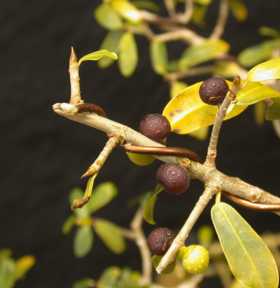
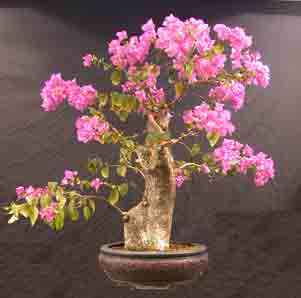
    This Ficus burtt-davyi 'Nana' was obtained from Jim Smith in 1992 as a small tree. It has lived indoors for all the subsequent years. It grows fairly slowly in its small pot and occasionally will have small green figs maturing into a maroon color. The seed of course is sterile since it does not have the help of fig wasps to fertilize it.

    Aerial roots form quite easily on this species. It grows slowly and seems to have definite growth and rest periods. Heavy trimming seems to put the tree into suspended animation for a period of time before it grows once again. Otherwise the plant is very suitable to bonsai work.

    The tree is 15 inches tall and two inches across the base of the trunk.

    All Rights Reserved © 2004 Jerry Meislik

    Back to Bonsai Gallery
  • Diospyros rhodocalyx

    Diospyros rhodocalyx

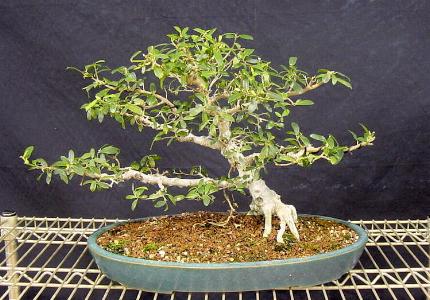
    This tree, Diospyros rhodocalyx has been under my care since 1990. I believe that it is related to the persimmon and is found in much of Southeast Asia. I have seen this material used as bonsai in Thailand, Vietnam, Singapore and Malayasia. It likes extreme heat and lots of water and fertilizer. I doubt that it would be happy growing in a normal home's indoor environment.

    Leaf pruning results in much smaller leaves. I have never seen it flower or fruit and have even been told that even in Asia that it rarely does so in containers.

    The wood is extremely hard and rot resistant. The outer bark is dark black and is its most attractive feature. Large cut scars on other trees are often stained white with lime sulfur to make the dead wood contrast with the living bark while cuts on this tree are concealed by darkening the cut surfaces with India ink or a black magic marker.

    One of the peculiarities of this tree species is its tendency to form multiple sprouts at the branch origins. These of course need to be removed to allow the desired branch to thrive.

    All Rights Reserved © 2004 Jerry Meislik

    Back to Bonsai Gallery
  • Ficus salicaria – Willow Leaf Fig

    Ficus salicaria – Willow Leaf Fig

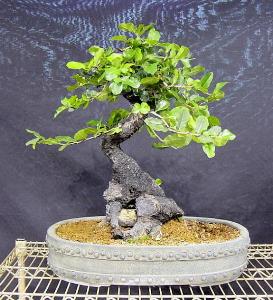
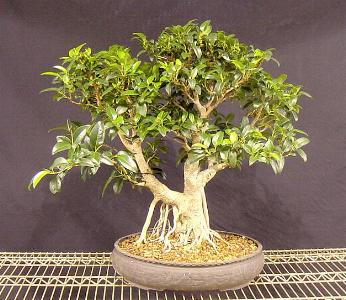
    This Ficus salicaria, older names include F. salicifolia, nerifolia, neriifolia etc., was purchased from Joe Samuels in 1983 as a rather small tree. It has lived with us since then as a summer patio plant or indoors under lights.

    The aerial root on the right was created by grafting a rooted cutting into the lowest right branch of the tree. Ficus salicifolia will form aerial roots readily under humid conditions. Grafting allowed me to place the aerial root exactly where I wanted it as contrasted to allowing nature to dictate where an aerial root might spontaneously appear.

    It is currently 23 inches tall with a trunk of 2.5 inches.

    All Rights Reserved © 2008 Jerry Meislik

    Back to Bonsai Gallery
  • Ficus rubiginosa ‘Australis’- Rusty Fig

    Ficus rubiginosa ‘Australis’- Rusty Fig

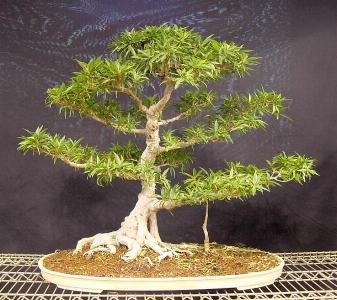
    This plant of Ficus rubiginosa was obtained from a friend who visited Australia and collected some ripe fig seeds. I obtained the plant from him as a 7 year old tree in 1984.

    The tree's leaves are quite large in relationship to the tree's size, but with defoliation the foliage can be reduced to only two inches. Defoliation is being performed twice yearly and is resulting in much more twig ramification. The lowest left branch shows the more normal large sized leaves while the top of the tree shows smaller leaves produced by defoliation.

    In this fig species aerial roots form easily under moist and humid conditions. Other figs have much more difficulty forming aerial roots.

    The plant is currently 25 inches tall with a main trunk diameter of 3.5 inches.

    All Rights Reserved © 2004 Jerry Meislik

    Back to Bonsai Gallery
  • Coccoloba uvifera – Sea Grape

    Coccoloba uvifera – Sea Grape

    The Coccoloba uvifera or Sea Grape was collected in Florida in 1992. It was originally a landscape tree that was shortened to about 20 inches in height. When collected all branches and leaves were removed to a bare trunk. The tree has been growing indoors under lights or in a greenhouse since collection.

    This plant has had no insect problems. It grows somewhat slowly, and most years it has just one growth spurt, and some years a second smaller growth spurt. Each year the new growth is allowed to harden off and then new growth is reduced back to several leaves. This has not resulted in much ramification, so in the last year the whole tree has been defoliated to try to induce more ramification. Time will tell whether this approach will succeed.

    Sea Grape leaves are naturally very large, up to 8 inches in diameter, making the process of creating a believable bonsai very difficult. Still, I really admire its exfoliating multi-colored bark and its tropical allure.

    Deadwood areas at the base of the trunk need detailed carving to refine the rough cuts. The heart-wood is dark red and is very hard and rot resistant. Even wood touching the wet soil takes some years to get soft and punky. Wood that does not touch the soil seems to remain sound for many years.

    The tree is 27 inches tall with a trunk caliper of nine inches.

    All Rights Reserved © 2004 Jerry Meislik

    Back to Bonsai Gallery