Author: Richard

  • Fusion

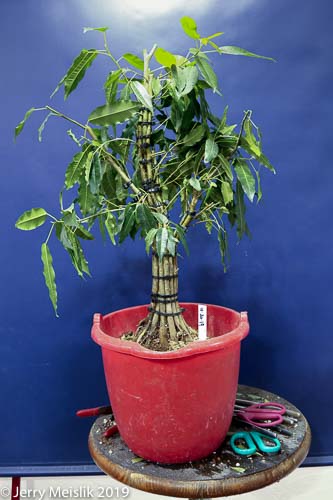
    Many of us do not have easy access to larger materials and must use small plants or cuttings to develop their bonsai. One way to utilize smaller material is to cultivate cuttings from a desirable plant. In this case it is a Ficus concinna with lovely new foliage that is quite red in color. I took multiple cuttings from the mother tree and rooted them. You can see the rooted cuttings in the first photo. Each is about 2-3 feet tall and in separate growing containers.

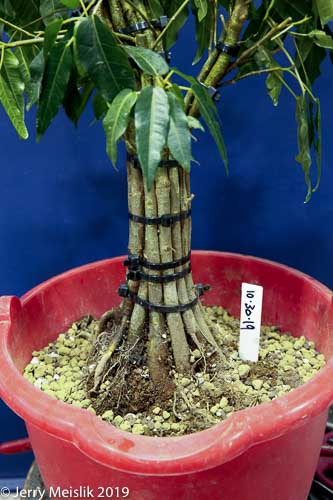
    One after another is brought as close together as possible by removing interfering branches and roots. They are then held with plastic cable ties or any other suitable non-stretching material to secure the trees tightly together and then planted into a large growing container. These trees will be allowed wild growth with as little trimming as possible. Over time the ties will begin to press into the bark and then they can be removed and replaced as needed until the fusion is complete.

    Over time branches are selected that grow out of the bundle are used in the final design of the bonsai. The end result is a larger tree than I could have developed in the same number of years in my plant room. If I lived in a tropical area I could have simply planted a tree in the ground and grown it for 5 years to get a thick trunk and then worked on developing the branch structure.
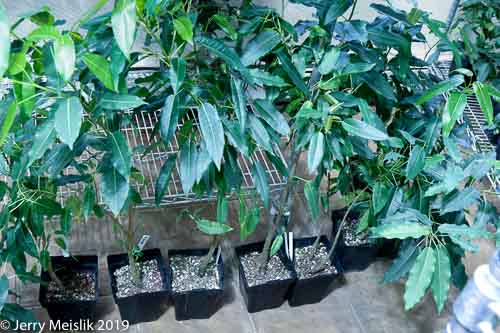
    Rooted cuttings in small growing containers will be fused
    Cuttings are brought tightly together with plastic cable ties
    Plants are placed into a large growing container
  • Ficus burkei ‘puberula’

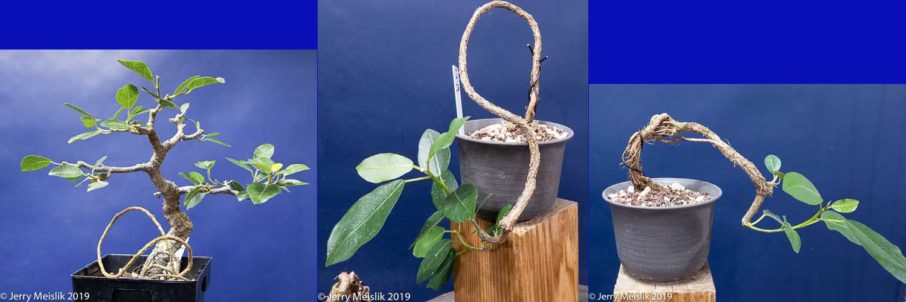
    The mother tree on the left and the two roots that were removed.

    Ficus burkei ‘puberula’ can grow roots up from the soil and into the air and then back into the soil. Why they do this is a mystery to me but it also occurs with other Ficus species. In this case I removed the two roots and they sprouted foliage from the cut end. They will be styled out as bonsai.

    I

  • Root-over-rock Ficus

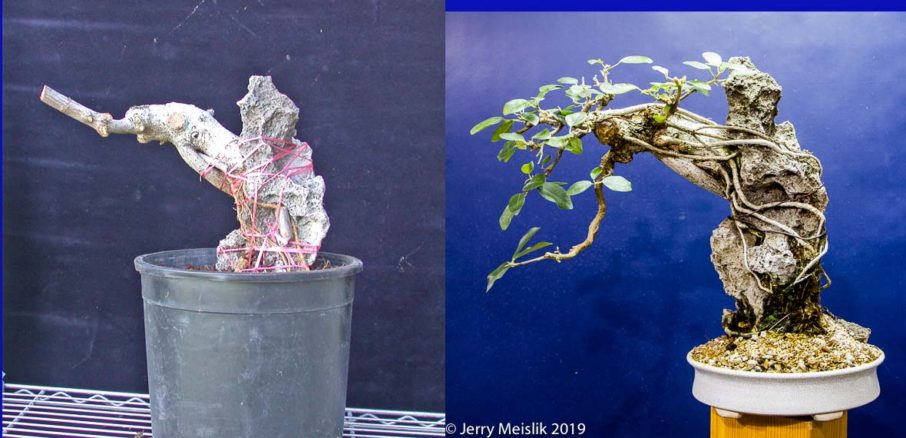
    Ficus are easy to develop into root-over-rock designs as they have aggressive roots that tolerate gradual exposture to air and the roots really do well growing over rocks. The photo is of a Ficus burkei ‘puberula’ cutting that was placed on the rock, roots wraped to keep them tight on the rock and then planted deeply so the roots were not exposed to air. Gradually over some years the soil was removed from the rock and the roots exposed. Done repeatedly the rock was elevated and more of the roots showing. This picture is about 10 years or so after the procedure was started.

    The tree about ten years before the image on the right was taken
  • My new book is here, The World of Ficus Bonsai

    My new Ficus book, The World of Ficus Bonsai


    At long last it is here. The World of Ficus Bonsai by Jerry Meislik. I have been learning more and more about Ficus and how incredible they are
    for bonsai and for growing in your home. I have expanded and added
    new material to create an enlarged and updated book on using Ficus
    for bonsai. The book is 324 pages full of great information and full of 
    pictures. It is available as a e-book or as a soft or hard cover book. 


    You can purchase it on: 
     
    Amazon – https://www.amazon.com/World-Ficus-Bonsai-Jerry-Meislik/dp/152553288X/ref=sr_1_1?keywords=The+World+of+Ficus+bonsai&qid=1555519664&s=gateway&sr=8-1
     
    Apple – https://books.apple.com/us/book/the-world-of-ficus-bonsai/id1460062986
     
    Friesens – https://books.friesenpress.com/store/title/119734000056702445/Jerry-Meislik-The-World-of-Ficus-Bonsai


  • Ficus tremula

    Ficus tremula

    One of favorite species for bonsai is Ficus tremula. I have only recently been able to find the species and started growing it. I originally saw the species in South Africa in the collection of Hennie Nel, a great bonsai artist and grower.

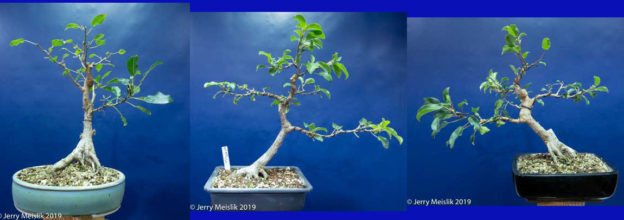
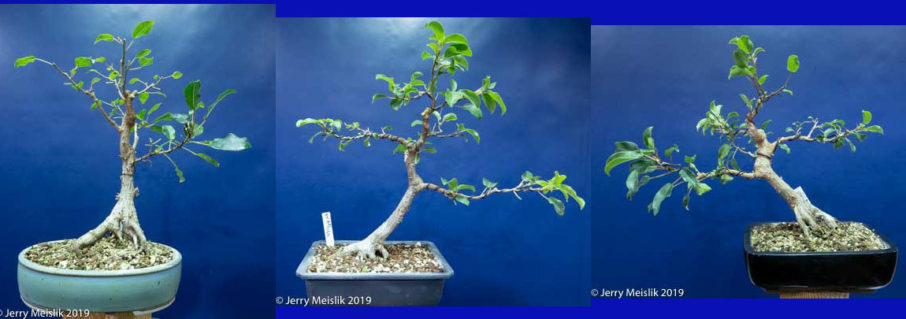
    The species grows easily from seed, cuttings and root cuttings. Leaves reduce well and it produces figs from the trunk at an early age. A few of my trees that are just several years old are shown in the photo.

    I think all bonsai and fig lovers should give it a try

    Three of my young Ficus tremula
  • Why won’t my Ficus cutting grow?

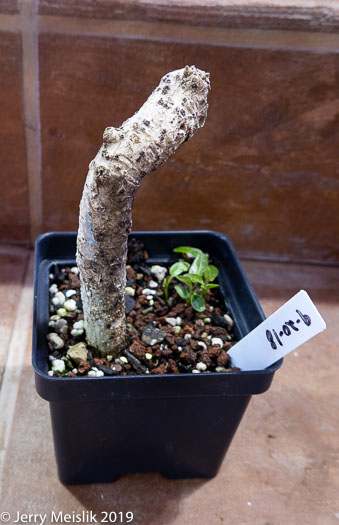
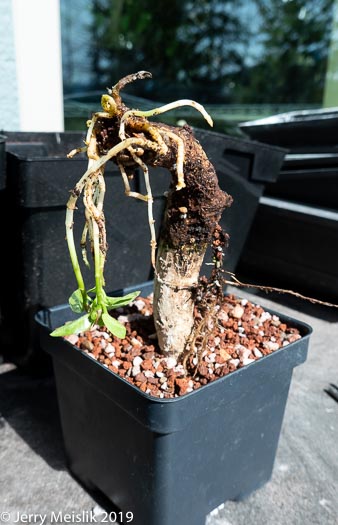
    Some 6 months I have been waiting for a cutting of Ficus burkei ‘puberula’ to show some signs of rooting. This is a long time for this Ficus species to show no evidence of rooting.

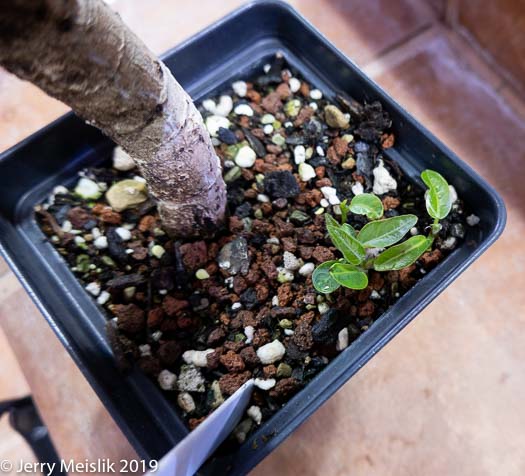
    I did see some foliage poking out of the soil in the corner of the pot. So, I unpotted the cutting and what did I discover?

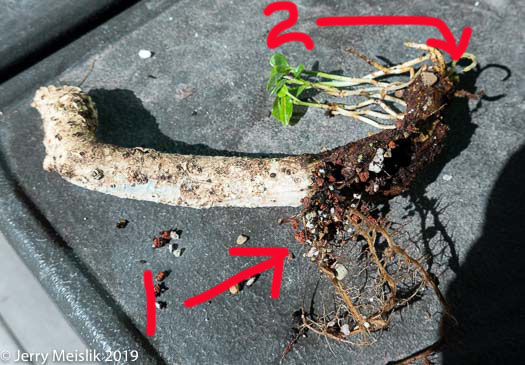
    The cutting actually had roots in the soil and at the end of the cutting. But, it also had roots and foliage coming from the “bottom” of the cutting!

    Conclusion?? I had potted the cutting upside down! Despite this fact the cutting was completely alive and roots were coming out in two places from the cutting as well as sprouting leaves from the bottom or more accurately what should be the top.

    I repotted the cutting and in a few weeks it will be growing normally and a lot more quickly. I do recommend that cuttings be placed properly oriented in the soil for the best results but the result indicates that figs can take this error in stride. Just another of the amazing capabilities of Ficus!

    Ficus burkei ‘puberula’ cutting with some foliage coming out of the soil

    Close up of the folaige
    1. Roots growing from the cutting 2. Roots and branches and foliage growing from the “bottom” of the cutting

    The cutting now planted the right way. Branches and foliage will soon grow back upright

  • Nearly 40 years

    This is a Ficus rubiginosa grown from seed collected by a friend while traveling in Australia. I bought the young tree from him about 40 years ago. The photo shows how the tree has evolved from the left side photo taken in 1985 to the right photo taken in 2019.

    Rubginosa is one of the strongest Ficus species that I have grown and responds really well to growing indoors under lights. Leaves are a bit large but with defoliation they reduce extremely well. Even aerial roots can form under moderately dry conditions.

    I recommend this fig species for all growers.

  • Creating a new branch with fusion

    Creating a new branch with fusion

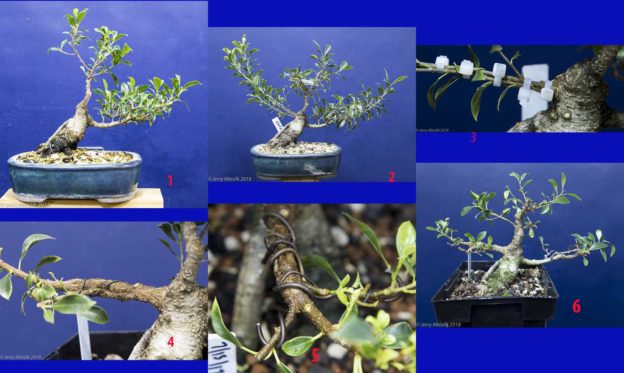
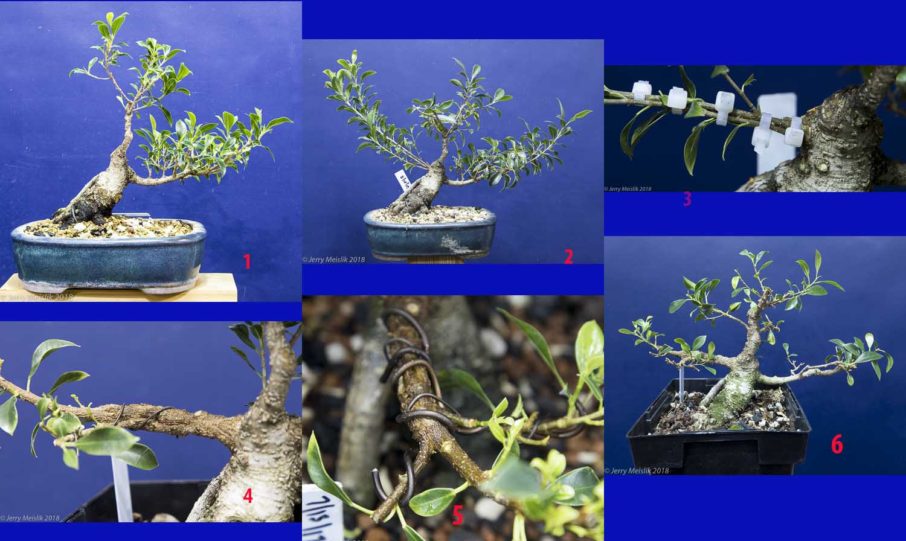
    In this Ficus microcarpa ‘melon seed’ I needed a left side branch. As you can see in image 1 there is no branch. Fortunately, several small branches sprouted in the right spot and to speed the development of the branch three of the sprouts were tied together with cable ties, image 2. Two of the branches were brought outward and used to develop side branches. All the branches were allowed to grow and to fuse. Side and front views of the branch show a nicely developing left main branch. Sometimes fusion will allow you to create a heavier and more detailed branch more quickly than with the usual techniques.

    Ficus microcarpa ‘melon seed’ progression of fused branch on left
  • Tilting the bonsai

    Sometimes a bonsai creation works well and sometimes a gentle adjustment in one factor can result in a great improvement. In this case a seed grown Ficus natalensis in the exposed root style appears to work quite well. Making a simple adjustment and tilting the tree to the right improves the design immensely. The left or original image shows a pretty much upright tree that is static. Tilting the tree to the right makes the design a bit more unstable but also allows the movement of the trunk to be emphasized.

    Ficus natalensis on left shows good stability while the image on the right is a bit more unstable but seems to help the flow of the trunk

  • Ficus rumphii

    A very worthwhile fig to grow is Ficus rumphii. It is used extensively in southeast Asia for bonsai.

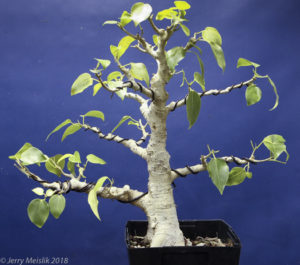
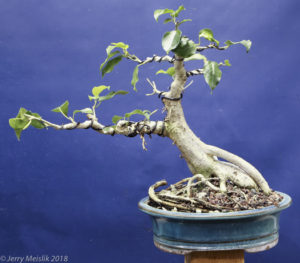
    The pictures show two rumphii that I grew from seed and that are now 12 years old. The bark on this species is light  in color as contrasted to religiosa which has a darker grey bark. Religiosa also has a longer drip tip on the leaves.

    Upright style of rumphii, about 16″ tall

    Slant style rumphii,15″ wide, the curving roots on the left will be removed.