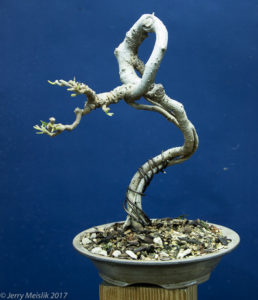
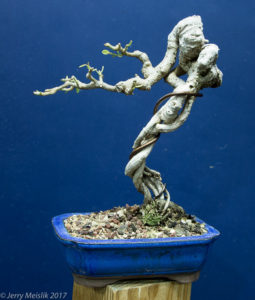
Author: Richard

  • Leaves vary a lot

    One interesting thing to know is that Ficus leaves can vary greatly. They can vary in size, shape, texture, color etc. They even can vary on the same plant or whether the plant is growing strongly or just slowly.

    Growing figs from seed reveals also that almost every seedling shows some subtle or not so subtle variations. The picture below shows two leaves grown from a Thailand seed source and the other from an Australian source. They are both the same species, Ficus virens, Lipstick fig, Red Balete, Spotted fig are all common local names for them.
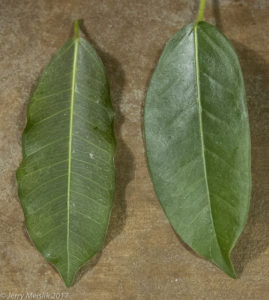
    Ficus virens, left is Thailand form, right is Australian form

    The two leaves really do not look similar and yet they are the same species! Makes me scratch my head trying to ID figs from across the world by just looking at the leaf. For a true identification the syconia or figs need to be seen. Unfortunately, we seldom see figs on our bonsai.

     

                                                                            To learn more about growing figs buy the definitive reference work on Ficus for bonsai. The book is a softcover, 8 by 10 inch volume, with 144 color pages, containing detailed information for the beginner as well as the advanced hobbyist. Click here for more information
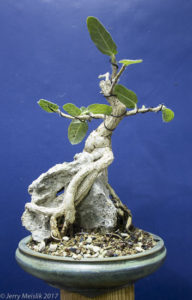
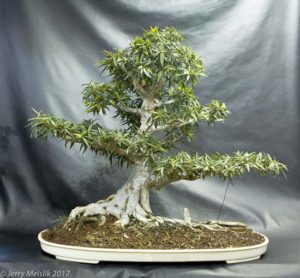
  • Ficus glumosa, uncommon bonsai

    An uncommonly found Ficus species, Ficus glumosa is from Africa and has nice round, hairy leaves. It is in the grouping of rock-splitter figs. Those that seem to be found growing over and around rocks in the veldt.

    Since they seem to enjoy rock growing this seedling was placed over the rock to emulate a root over rock style. It is in a small pot so its growth is quite limited and despite its age, about 12 years, it is still a very immature bonsai design.

    Ficus glumosa root-over-rock style
  • Ficus salicaria, Willow Leaf fig

    One of the best small leaf fig species to use for bonsai is the Willow Leaf fig, scientifically called Ficus salicaria. It has many great features including aerial roots and wide-spreading surface roots. One possible issue is that it does not like having roots that stay too wet. Water the tree well and make sure to allow the soil to nearly dry before watering it again. Continually wet roots leave room for fungal and other rot problems.

    Willow Leaf tree that I lost due to root rot
  • The Edible Fig, Ficus carica

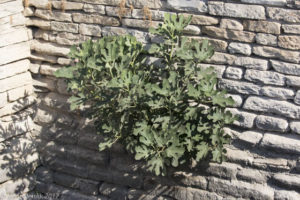
    Ficus carica, the edible fig, is grown throughout the world for its delicious sweet figs. It prefers growing in climate areas that have some sort of resting season, either from cooler winter temperatures or a dry season. I have tried growing it in a tropical greenhouse without a proper cool or dry period and found that it does not grow well for me under these conditions.

    Ficus carica growing out of cracks in a rock wall
    Close up view of the fig
    Yet, another specimen growing out of a rock wall

    For interest I am showing a few specimens that I saw growing out of rock walls during a recent trip to Greece.

  • How to stimulate latent buds in the trunk

    Ficus microcarpa with few branches worth working with in the lower trunk.
    After chopping the trunk down you can see the huge number of new branches that will be used to shape a bonsai tree
  • Bunjin style

    Bunjin or literati style is a less common bonsai style. It mainly relies on the line of the tree for its focal point. The canopy and the pot should be minimal to keep the focus on the line of the tree. It is a style that has its admirers as well as many that do not like it. I have a short article at https://suspicious-pike.51-195-201-14.plesk.page/bonsai-culture-and-care/general-bonsai-information/the-bunjin-or-literati-style/

    Ficus ‘Mexicana’ showing an interesting trunk line, minimal canopy, and restrained pot


  • Playing with images to design your tree

    One thing that I find very useful is to photograph my trees on a regular basis. This allows me to see how the trees progress over time and lets me photographically change the images to see if a better design emerges from the image manipulations.

    A series of pictures to illustrate how the design might change after playing with image manipulations.

    The Ficus benghalensis as it looked some years back, straight trunk and large leaves
    Using some heavy wire the trunk was bent to create some movement in the trunk
    The tree partially defoliated as it looks today
    With Photoshop one section of the tree was removed. Is it a better desgn?
    Yet, another piece is removed graphically. Is this one better?
  • Creating something from nothing

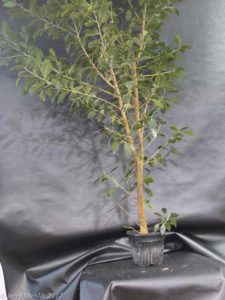
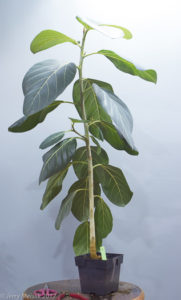
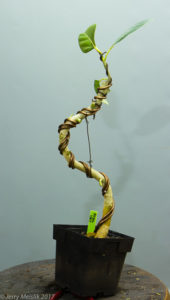
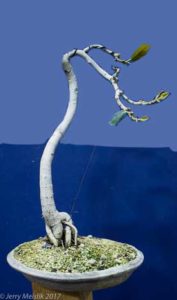
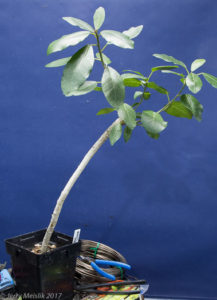
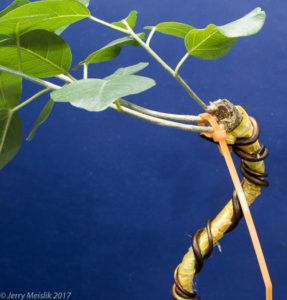
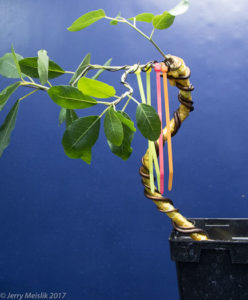
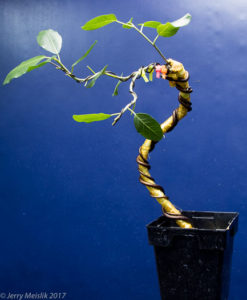
    Ficus ‘Mystery’ developed from root cutting, having little interest
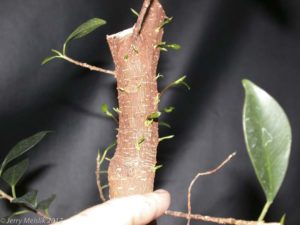
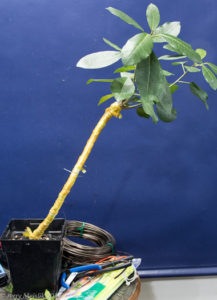
    Wrap the trunk with plastic ribbon
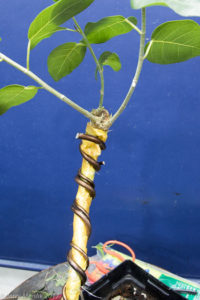
    Apply heavy wire over the ribbon
    Take two small branches and fuse them with cable ties
    More cable ties placed along the branches to help fusion and develop a heavier branch more quickly
    Final result is a more interesting plant that one day could become a pretty bonsai
  • Making your bonsai taller

    With exposed root bonsai it is possible to create a taller tree. One can simply raise the tree up on its finer root system while keeping it supported with wire until the new roots harden sufficiently to make the trunk stable.

    The new roots will need to be covered for some months until they harden off and become adapted to dry air. Once so adapted the alluminum foil can be removed.

    Ficus in exposed root style but a bit too short
    Root system elongated,  wire used for temporary support
    Foil is placed for some months until newly exposed roots are stable
  • Twisting and Turning

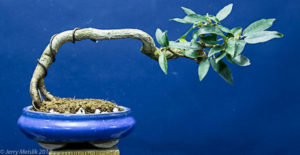
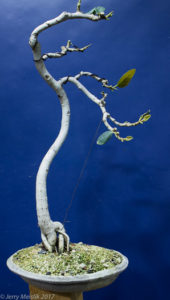
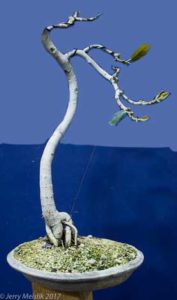
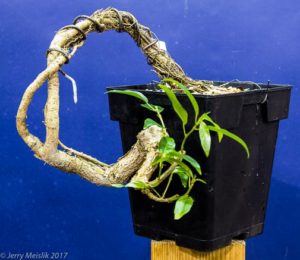
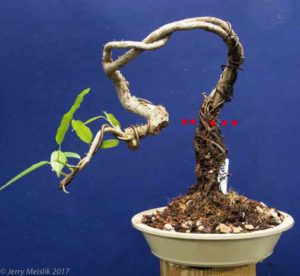
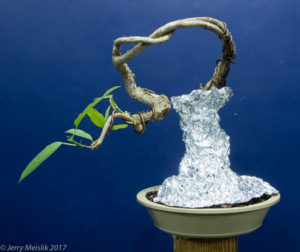
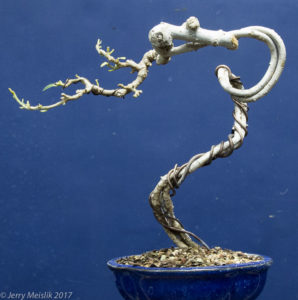
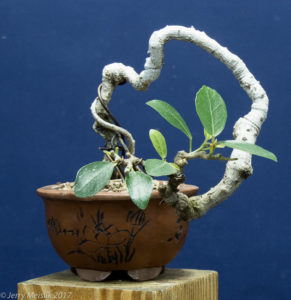
    When presented with material that is young and lacks interesting features I will search for ones that have twists and turns. Great bonsai can be created from this rather unexciting material. Using wire to shape long and limber pieces is another way to introduce interesting shapes. Another way is to use root cuttings that often have great shapes, The pictures below are all of Ficus ‘Mystery’, a fig that is not identified yet.

    Ficus ‘Mystery’
    Ficus ‘Mystery’
    Ficus ‘Mystery’
    Ficus ‘Mystery’                                                                        


                                                                            To learn more about growing figs buy the definitive reference work on Ficus for bonsai. The book is a softcover, 8 by 10 inch volume, with 144 color pages, containing detailed information for the beginner as well as the advanced hobbyist. Click here for more information