Author: Richard

  • Eastern larch – Larix laricina – Autumn Foliage

    Eastern larch – Larix laricina – Autumn Foliage

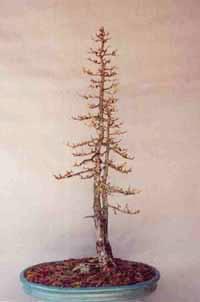
    This twin trunk Eastern larch, Larix laricina, was found on a bog in Northern Michigan and collected in the fall of 1985 and placed into a growing bed. It was potted into this container and has remained there for the last 19 years. It is repotted every two or three years. At the time of collection it was approximately 85 years old . This was determined by a ring count performed on the base of the tree.

    One summer a finch placed her nest and raised 4 young in this tree! What a nice affirmation when a wild bird accepts the tree as its home.

    Larches are deciduous conifers and their needles turn yellow in the fall and then are shed. The new leaves appear in late spring and some years small seed cones are formed.


    Although the Eastern Larch is often found growing on bogs, they prefer to grow in normal bonsai soil and receive normal watering. They are extremely cold hardy and will not have any winter kill. They will not break back on old wood so do not trim them back beyond the needles.

    Wire the tree in spring before the needles elongate as this is much easier than trying to wire when the foliage is out, and the growing points are easily damaged. Larches take wiring well and seem to stay where they are wired.

    This larch is 44 inches tall.

    All Rights Reserved © 2004 Jerry Meislik
    Back to Bonsai Gallery

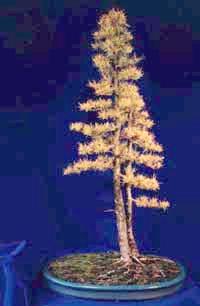
  • Eastern larch – Larix laricina – Without Foliage

    Eastern larch – Larix laricina – Without Foliage

    This twin trunk Eastern larch, Larix laricina, was found on a bog in Northern Michigan and collected in the fall of 1985 and placed into a growing bed. It was potted into this container and has remained there for the last 19 years. It is repotted every two or three years. At the time of collection it was approximately 85 years old . This was determined by a ring count performed on the base of the tree.

    One summer a finch placed her nest and raised 4 young in this tree! What a nice affirmation when a wild bird accepts the tree as its home.

    Larches are deciduous conifers and their needles turn yellow in the fall and then are shed. The new leaves appear in late spring and some years small seed cones are formed.


    Although the Eastern Larch is often found growing on bogs, they prefer to grow in normal bonsai soil and receive normal watering. They are extremely cold hardy and will not have any winter kill. They will not break back on old wood so do not trim them back beyond the needles.

    Wire the tree in spring before the needles elongate as this is much easier than trying to wire when the foliage is out, and the growing points are easily damaged. Larches take wiring well and seem to stay where they are wired.

    This larch is 44 inches tall.

    All Rights Reserved © 2004 Jerry Meislik
    Back to Bonsai Gallery

  • Cotoneaster sp. on rock

    Cotoneaster sp. on rock

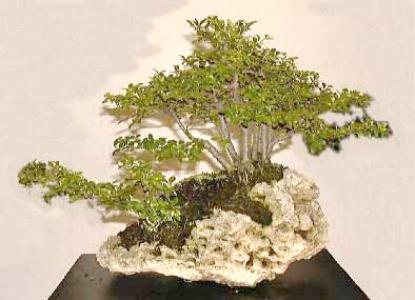
    This planting was done as a demonstration for the Ann Arbor Bonsai Society in August of 1989.

    The individual plants were container grown for several years from bird seeded cotoneasters found in my back yard. Although the time of year was wrong for transplanting, the show went on, and the plants were bare rooted, root pruned and placed onto the rock. Despite this the plants had no problems and grew well on the stone.

    The trees are never removed from the rock or root pruned. Some fresh soil is occasionally added to the planting. Flowering and fruiting occur each spring followed by lovely tiny red apples each fall; these are promptly eaten by birds.

    The planting is now in the bonsai collection of the University of Michigan, Matthaei Botanical Gardens.

    The planting is 15 inches tall.

    All Rights Reserved © 2004 Jerry Meislik
    Back to Bonsai Gallery

  • Wrightia religiosa – Water Jasmine

    Wrightia religiosa – Water Jasmine

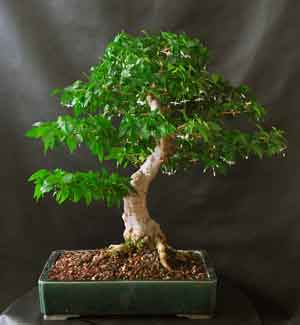
    This plant was purchased in 1993. The tree is easy to grow and is not susceptible to insect problems.

    It likes to be kept moist but not constantly wet. It is fertilized when in active growth. It can be brought into flower by removing all the leaves and about 3 weeks later flowers will form on the new growth. Left alone, it blooms twice a year with very fragrant white blossoms.

    The fruit is a long bean-like affair with small feathery seeds that are easy to grow; very similar to a milkweed seed pod.

    This tree is 21 inches tall and has a trunk diameter of 4 inches.

    Propagation from cuttings and seed is easy. See more information on Wrightia here.

    All Rights Reserved © 2007 Jerry Meislik

    Back to Bonsai Gallery

  • Ficus microcarpa – Chinese Banyan (Taiwan, 1989)

    Ficus microcarpa – Chinese Banyan (Taiwan, 1989)

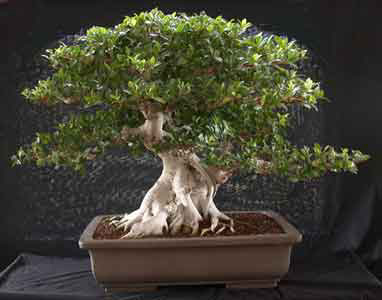
    This tree was purchased in Taiwan in 1989 and shipped by air to the United States. It has lived very happily in my greenhouse for these years.

    It has been encouraged to develop secondary and tertiary branching and a general refinement of its structure. The trunk has seemingly not grown but the branches have thickened significantly and the apex has matured. It is wired twice a year, wild growth is trimmed frequently and the tree has been leaf pruned once a year for the last several years. It takes about 7-9 hours to wire this large tree completely and almost the same amount of time to unwire it a few weeks later.

    I would like to eventually plant the tree in an oval pot with grey or green glaze.

    This tree is 30 inches tall and the trunk is 10.5 inches wide at the first branch level.

    All Rights Reserved © 2004 Jerry Meislik
    Back to Bonsai Gallery

  • Fortunella hindsii – Hong Kong Kumquat

    Fortunella hindsii – Hong Kong Kumquat

    Fortunella hindsii or Hong Kong Kumquat is in the citrus family of plants. It tolerates pot culture better than many of the other plants in the citrus family. I purchased this tree as a seedling about 18 years ago from a Florida grower. The species is seen frequently in the Kokufu Ten Japanese picture books and is used in mainly shohin size. It has small spines and blooms once or twice a year with small very fragrant white citrus scented flowers. These flowers are followed by tiny "oranges" which are perhaps one half to three quarter's inch in size, and of excellent scale to the small size of the tree. The plant is extremely easy to propagate from seed, hardwood cuttings, as well as from air layers. It is difficult to propagate from root cuttings.

    Allow the plant dry beween waterings as citrus do not like to be wet all the time and use a fairly porous soil mix to allow good air circulation to the roots. Wire the branches while they are green since woody (brown) branches will break before they bend. Fertilize the tree well when it is in active growth.

    This tree is 10 inches tall and the trunk diameter is 2 inches.

    All Rights Reserved © 2002 Jerry Meislik

    Back to Bonsai Gallery

  • Ficus microcarpa – Chinese Banyan (Taiwan Nursery)

    Ficus microcarpa – Chinese Banyan (Taiwan Nursery)

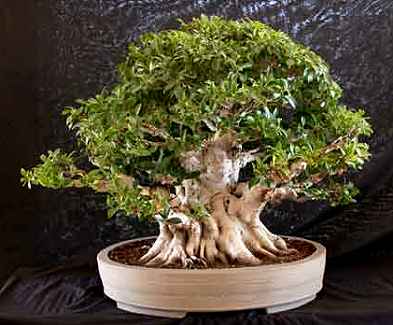
    This Ficus was purchased from a nursery in Taiwan and imported into the USA. It has a very powerful trunk and root flare.

    Much work has been done on this tree over many years to improve its form. There are signs of multiple grafts to improve the branch structure and grafts done to heal over scarred trunk areas. There are also very well healed cuts signifying many years of careful cultivation.

    This tree is 29 inches tall and the trunk diameter is 14 inches.

    All Rights Reserved © 2004 Jerry Meislik
    Back to Bonsai Gallery

  • Ficus salicaria – Banyan Style

    Ficus salicaria – Banyan Style

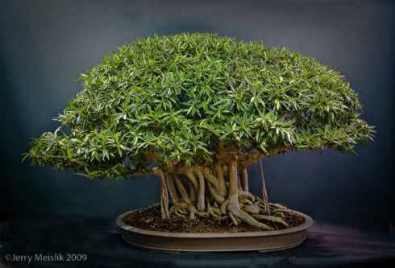
    This Ficus salicaria (F. salicifolia, nerifolia, neriifolia, Willow Leaf Ficus, etc.) is in the banyan style.

    The tree is approximately 40 years of age, and was grown and trained by the famous Ficus grower Jim Smith of Vero Beach Florida. I acquired the tree from Jim in 1999.

    The banyan style is one in which the tree has aerial roots or trunks in addition to a "main trunk". The banyan trees are named after East Asian Indian traders who would sit under these large trees to conduct their business. Such natural trees may be seen in tropical climates where the humidity level remains high during certain periods of the year. Aerial roots arise from small bumps on the main trunk or branches. Given persistent high humidity these small bumps elongate, reach to the soil and anchor themselves. Once in the soil the roots thicken rather quickly and form secondary trunks.

    This tree is 48" inches long.

    To learn more about aerial roots click here.

    All Rights Reserved © 2009 Jerry Meislik

    Back to Bonsai Gallery

  • Willow Leaf ficus after 20 years

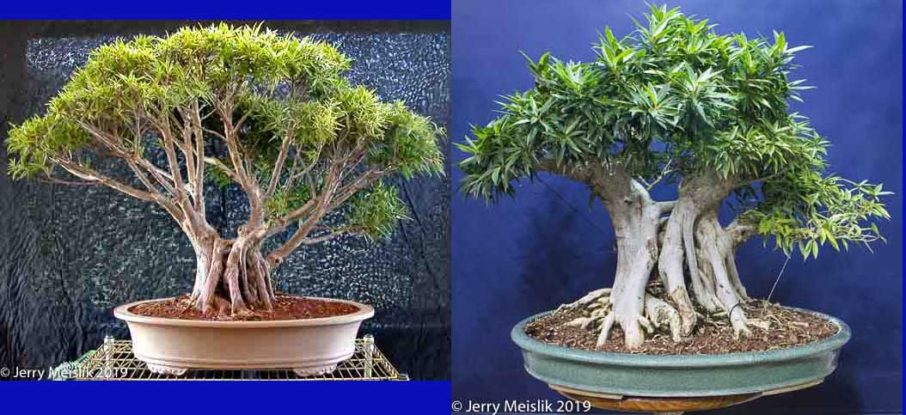
    I started working on this tree nearly 20 years ago. It was a large Ficus salicaria, Willow leaf ficus, purchased from a Florida nursery and selected by my friend and bonsai artist Joe Samuels. Joe passed away some years back and was a great help to me in advancing my bonsai knowledge. The tree was a huge piece about 30 inches tall and with little or no low or inside foliage. I grew it for several years and decided that to become a good bonsai it would need to be reduced in size to bring the focal point back to the heavy trunk and large aerial roots coming from the trunk.

    I reduced it pretty drastically and grew it on for about 4 more years when I finally came to the conclusion that I had not reduced it enough and I chopped it back even more. This slow decision making lost me 5 years or more in developing its final design. In the image below you can see the tree pretty much as it looked 19 years back and on the right is how it looks now. It is much smaller but still it is in a 20″ pot.

    Ficus salicaria on the left about 2001 and on the right in 2020
  • My new Ficus book

    It is getting close to Christmas and the holidays. If you have a bonsai friend or Ficus lover that needs a great book please consider buying a copy of my new book, The World of Ficus Bonsai. You might even want to buy one for yourself.

    I will sign your copy and even add a custom note in the book if you desire. You can order a soft cover copy by going to PayPal and sending $35 to bonsaihunk@hotmail.com

    This is available only in the USA. Please include your e-mail, name, mailing address and your wish for a custom note or not. The book will be mailed via USPS Media Mail and should get to you before Christmas. Thanks.