Author: Richard

  • Aerial roots are fabulous but…

    Aerial roots are often a great feature for a Ficus bonsai. However, not all bonsai shapes will benefit from aerials. In addition aerials can be difficult or impossible to grow depending on the species of fig; some figs will not produce aerials and even ones that do produce aerials may need very high humidity that persists for weeks.

    This is a Ficus that produces aerials in an insane fashion and forms them even under low humidity. The problem is that the plant itself does not grow quickly and refuses to branch well. Thus, creating a bonsai with this material will be impossible.

    So sad.
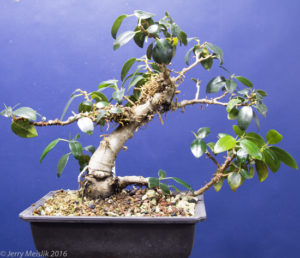
    RubAer_23A1638
    Ficus rubiginosa that produces copious aerials but refuses to grow well
    RubigAer_23A1642
    Close up view showing the abundant aerials produced in a dry climate area
  • Ficus burtt-davyi cutting after 5 years

    Ficus burtt-davyi is a very useful plant for bonsai. It can form nice bonsai in even small size due to its leaves that can become quite small under proper cultivation. There are also several clones that vary from normal to very small leaves.

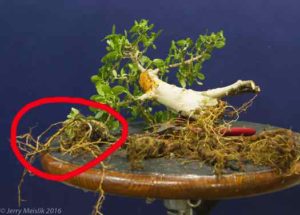
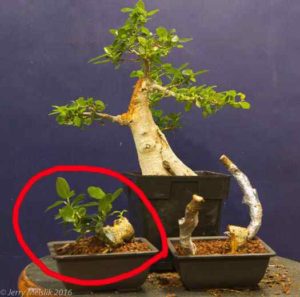
    The photos below show a larger BD fig that was cut into pieces and the one circled in red is a very small piece that was potted up.

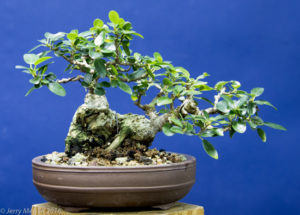
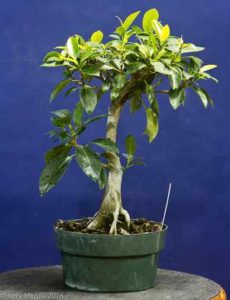
    The last shot shows the small tree after about 5 years of growth.


    _MG_5000
    Original mother tree cut into several pieces.
    2011_5001
    The pieces potted up individually, 2011
    _23A1452
    The same plant in 2016
  • Some recent bonsai work

    Spending a few hours in the growing room and changed and updated a few of my figs.

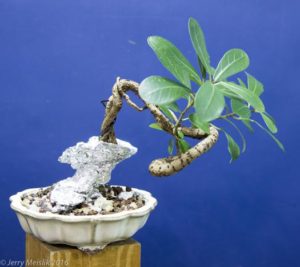
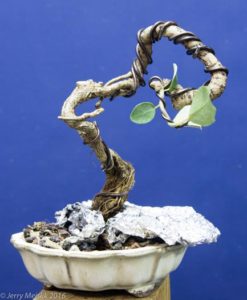
    1. Ficus natalensis grown from a root cutting. Aluminum foil was used to protect the new root cutting from dehydration. Soon it will be removed.
      _23A1529
      Root cutting taken a few months back
      _23A1539
      Trunk shape achieved with wiring. Next step to form the branches and canopy to suit the trunk shape


    2. _23A1598
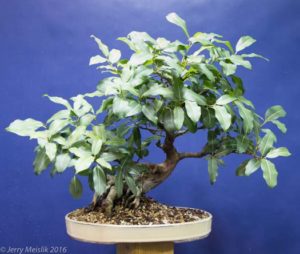
      Ficus virens has grown out of shape and needs a haircut

      _23A1603
      Ficus virens after trimming
  • How to thicken a branch

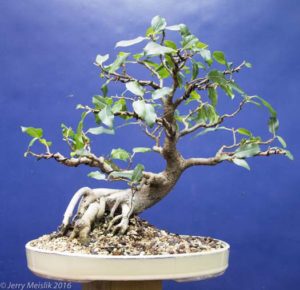
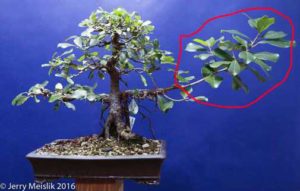
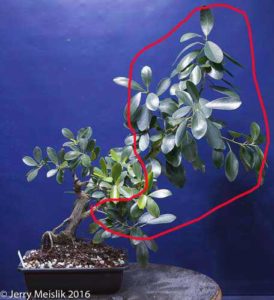
    On this bonsai Ficus natalensis the lowest branch on the right side is not thick enough. Most often the lowest branch should be the thickest on the tree. In order to achieve proper thickness the branch is allowed to grow longer than the style dictates. Note the leaves are also larger than the rest of the tree which is being trimmed regularly.

    In a year or two the branch will thicken because of its continued growth and then it will be appropriately shortened. The next step will be to continue the process of shaping the branch properly.

    The area in red is allowed to grow without trimming to thicken the branch
    The area in red is allowed to grow without trimming to thicken the branch
  • Slave branches

    Slave branches are used to thicken a part of the trunk or branch that needs to be heavier. Slave branches are allowed to grow wildly without trimming and when the thickening has been achieved they are removed.

    This Ficus natalensis has a slim trunk that would be improved by thickening it to introduce some more taper. The branch outlined in red was allowed to grow for a year or two to thicken the trunk.

    slaveon_23A0798
    Slave branch on this Ficus natalensis to thicken the lower trunk of the tree
    _23A0806
    Lower trunk has been thickened sufficiently so the slave branch has been removed


  • Aerial roots

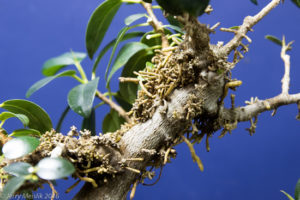
    This clump of Ficus virens/infectoria is seed grown and by being kept in a small container the individual trees now are fused and live on a common root system and lower trunk.

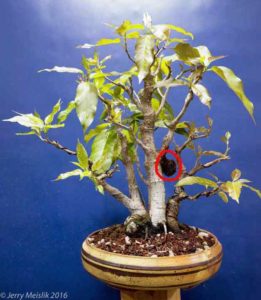
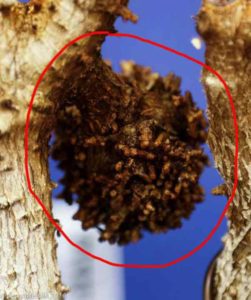
    Of interest is the somewhat peculiar formation seen in the red outline. It is an aerial root that has existed for quite a few years. The aerial initially formed as a small thread-like structure but because the ambient humidity is low it has never reached the soil to form a pillar trunk. Each year when humidity is high new aerials try to sprout from it  but as the high humidity is only temporary the aerials never succeed in elongating and reaching to the ground. It gets thicker each year and the “ball” is enlarging year by year.

    The appearance now is of a solid wood ball on which spikes that are aborted aerials jut out. Perhaps one day I will cut it off and see if I can root it as a cutting.

    Ficus virens/infectoria showing the aborted aerial root growing off the trunk
    Ficus virens/infectoria showing the aborted aerial root growing off the trunk
    _23A0389
    Closer view of the aerial and the spikes growing from it


    The definitive reference work on Ficus
    for bonsai. The book is a softcover, 8 by 10 inch volume, with 144 color pages, containing detailed information for the beginner as well as the advanced hobbyist.

  • Creating a bonsai from a cutting

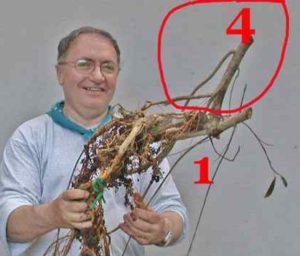
    Taking cuttings is one of the best ways to start a bonsai tree. In this example a cutting of Ficus ‘Mystery’ was taken. It was a long straight piece of stem with several aerial roots. A cutting taken with aerial roots is almost guaranteed to root.

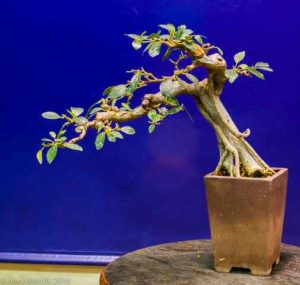
    In this case the cutting rooted successfully and several years later the bonsai created was an attractive semi-cascade tree.

    I take cuttings regularly and place them in bonsai soil and enclose the pot and cutting in a plastic bag to keep the humidity high. The bag is kept out of direct sunlight but in good bright light. Open the bat and water the soil as needed to keep the soil from getting dry but do not keep the soil totally full of water.

    The bonsai created from section 4 of the photograph
    The bonsai created from section 4 of the photograph below
    41Edit
    Section 4 with its aerial roots was taken as a cutting


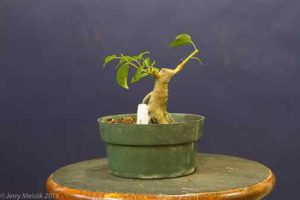
  • Starting with less than wonderful material

    _MG_3647-2
    2011, at the start not looking too promising

    This is a pretty typical plant. Ficus rubiginosa, that one can purchase in a nursery. It has had little or no training and seems unlikely to develop into a bonsai tree.

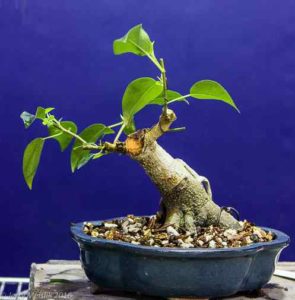
    First step a chop to reduce the height
    First step a chop to reduce the height
    Allowing growth
    Allowing growth
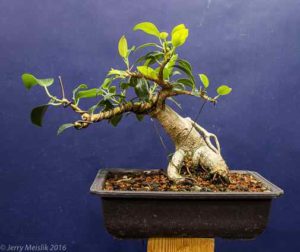
    More growth, some trimming to shape
    More growth, some trimming to shape, and wiring
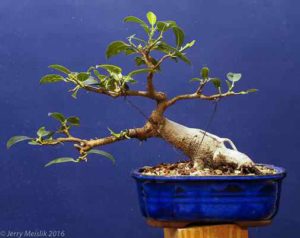
    2016, partially defoliated to encourage more twigging
    2016, partially defoliated to encourage more twigging  

    At last one begin to see the potential bonsai emerging from its rather humble beginnings.

  • Root-over-rock style

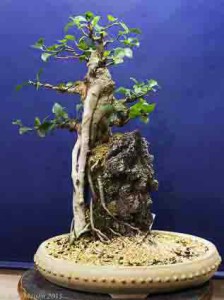
    Ficus microcarpa placed on this rock about 12 years ago
    Collected Ficus microcarpa placed on this rock about 12 years ago

    Figs grow very well when placed on or grown over a rock. Root-over-rock designs are also very much admired by bonsai lovers.

    Figs with their aggressive root systems easily tolerate being placed over a rock. The rock is covered with soil and the tree is allowed to grow vigorously to attach the roots to the rock. The soil is gradually removed over time to reveal the roots.

    This Ficus microcarpa tree was collected with my bonsai friend David Fukumoto about 12 years ago and placed on the rock, roots initially covered by aluminum foil to protect the new roots. Over time the foil was removed and the roots were now air adapted.


  • Multi-trunk fig tree

    An unusual style for fig trees is the multi-trunk style. One way to develop this style is to use a seedling Ficus and allow several trunks to form. Another way is to fuse several trunks together.

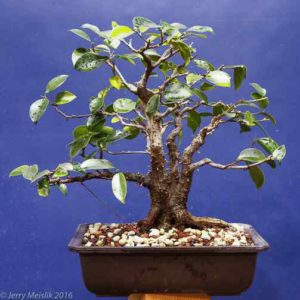
    This is a Ficus microcarpa, about 12 years from seed. It spontaneously had several low branches as a seedling and these were developed into a multi-trunk style.

    Ficus microcarpa from seed, age abou 12 years, height 8"
    Ficus microcarpa from seed, age about 12 years, height 8″
    _23A8452
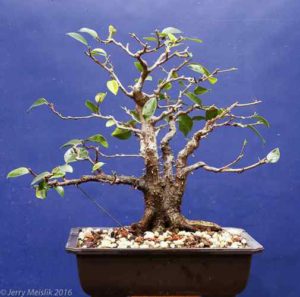
    Nearly defoliated to show the nice structure developing