Author: Richard

  • The evolution of a large Ficus microcarpa – Part Two

    The first 5 years of progress with a Ficus microcarpa, Chinese Banyan, was outlined in a previous blog see https://suspicious-pike.51-195-201-14.plesk.page/?s=part+l

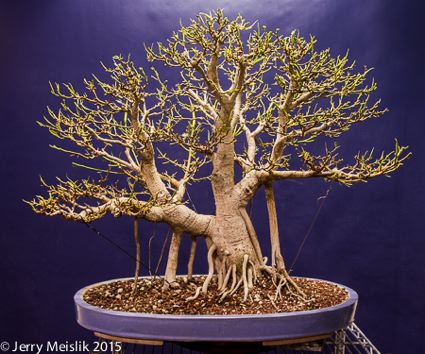
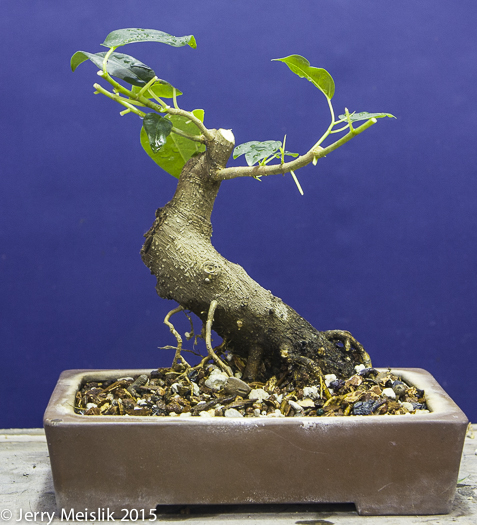
    This  is an update on how this fig has progresse as of April, 2015. It still has some years of refinement to undergo before it can claim its position as a mature bonsai.

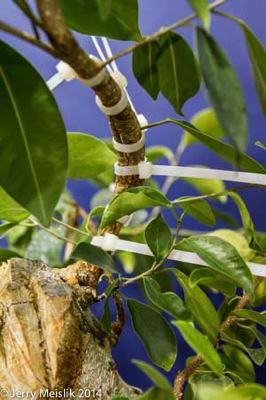
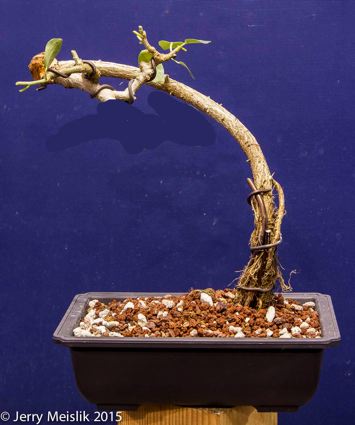
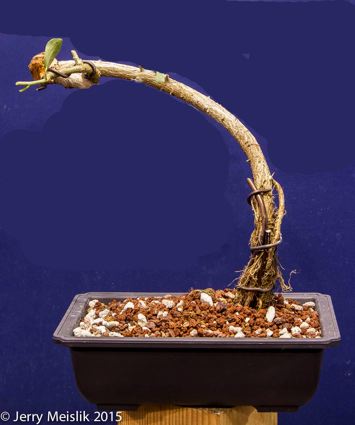
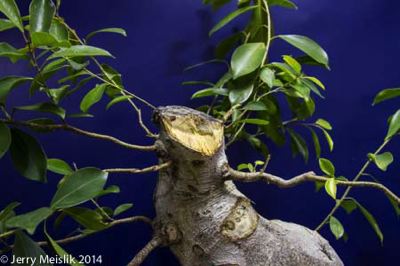
    Two procedures were accomplished today that are helping bring this bonsai in training a step closer to its end point. One, is to reveal the thickening produced by the second set of fusion grafts of rooted branches that were started 5-6 months ago.
    Apex dated as a single sprout of very thin dimension
    Apex  as a single sprout of very thin dimension, allowed to grow wildly to thicken it up, 2013
    9Fuse1Close_6740
    First set of fusion grafts are successful but not yet thick enough, 2014
    Fusions at apex current appearance, 2015
    Second set of fusions at apex current appearance, 2015
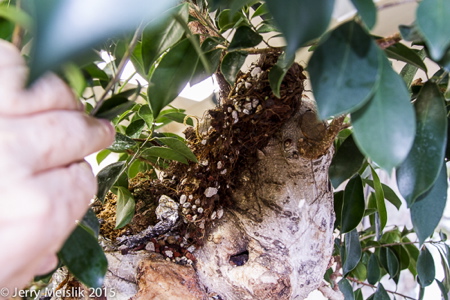
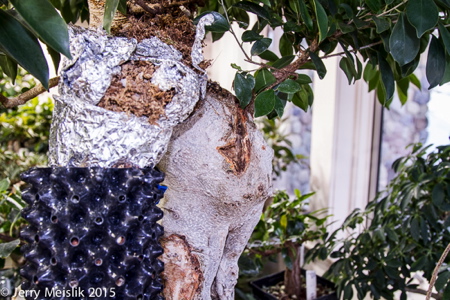
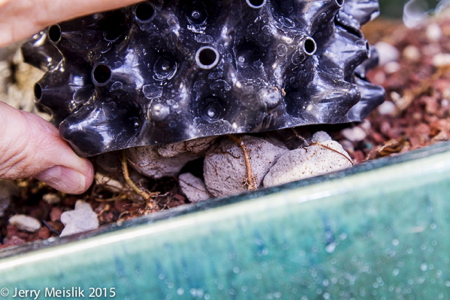
    Roots from fusion in moss conduit leading to plastic container to the bonsai pot
    Roots from fusion in moss conduit leading to plastic container to the bonsai pot
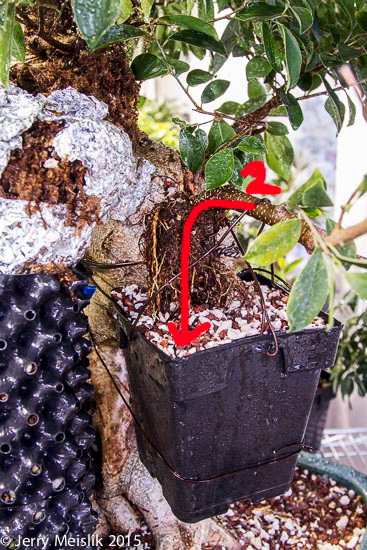
    Plastic pot of soil leading roots down
    Plastic pot of soil leading roots down to the soil in bonsai pot
    Roots can be seen already growing into the bonsai pot
    Roots can be seen  growing into the bonsai pot
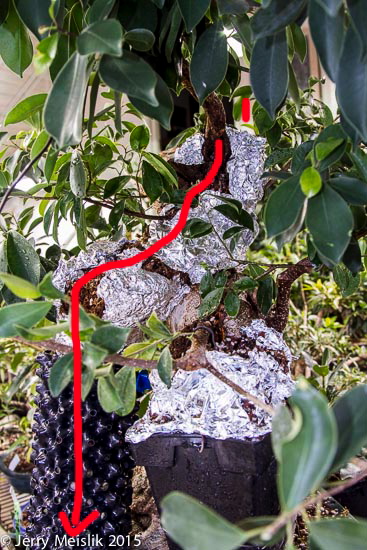
    Red arrow shows the path of the roots from the apex fusions to the bonsai pot
    Red arrow shows the path of the roots from the apex fusions to the bonsai pot

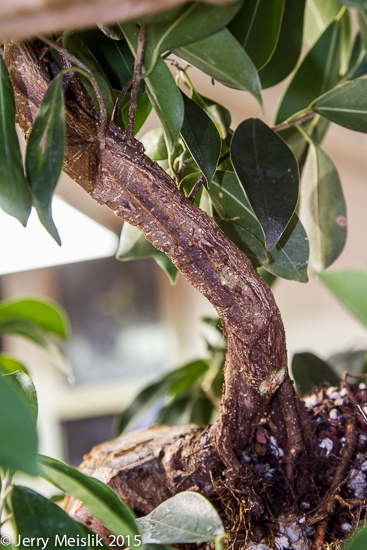
    The second procedure was the approach graft  on the right . Previously 3 approach grafts were tried and all failed for various reasons. A fourth approach graft  was done today to once again try to get a branch established in this position. Since it it is the first branch and lowest branch on the right side of the tree it is crucial to have this set in proper position of good size and of the right shape as it will be key to setting the design of the rest of the bonsai tree.
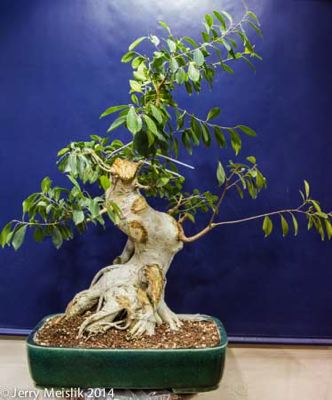
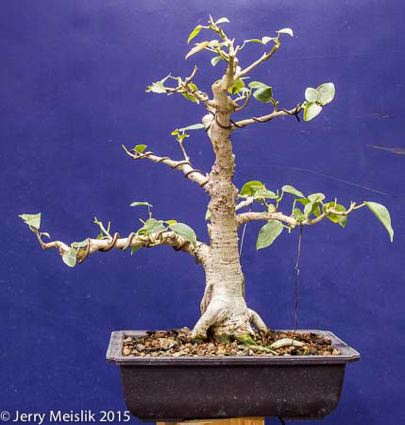
    Bonsai with first branch on right grafted and first set of apex fusions underway at the top of the tree, 2014
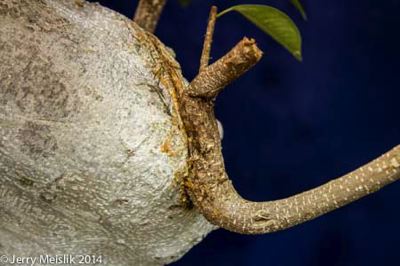
    Close up of the graft showing already severed from the origin and soon to be knocked of and grown on its own to become the 4th approach graft
    Close up of the lowest right graft already established on its own but soon to be accindentally knocked off – planted and grown on its own to become the 4th approach graft
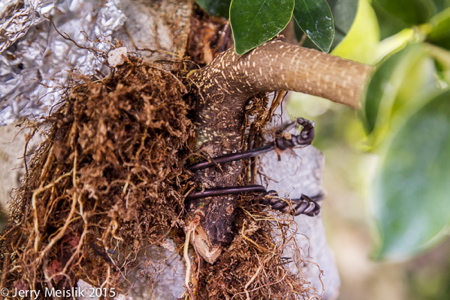
    Rooted cutting flipped vertically and graft held to stock with wire
    Above cutting, rooted, flipped vertically and graft held to stock with wire
    Fusions at apex current appearance, 2015
    Approach graft’s root are led into the pot of soil, 2015

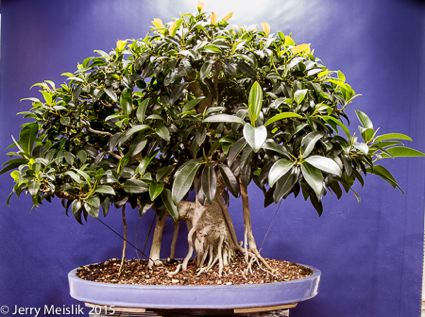
    As of 2015 the process is now 5 years along since started by Jack Pollock and the tree is moving along amazingly well. I am guessing that another 3-5 years will pass by before the tree is an attractive bonsai. In the meanwhile the tree has provided me a lot of reason to continue to learn and grow in  the wonders of the bonsai world.


    The definitive reference work on Ficus
    for bonsai. The book is a softcover, 8 by 10 inch volume, with 144 color pages, containing detailed information for the beginner as well as the advanced hobbyist.
     Click here for more information

  • An unusual species, Pyracomeles vilmorinii

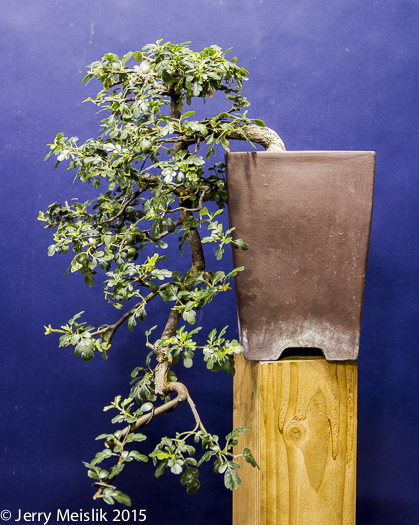
    Some 20 + years ago a dear friend gave me a rooted cutting of an unusual plant. It is supposedly a cross generic hybrid of Pyracantha and Osteomeles. The plant has survived growing indoors for all these years and makes an attractive cascade or semi-cascade as it seems to like growing a bit downwards.

    Approximate size of the original cutting some 20 years ago
    Approximate size of the original cutting some 20 years ago
    _MG_3262
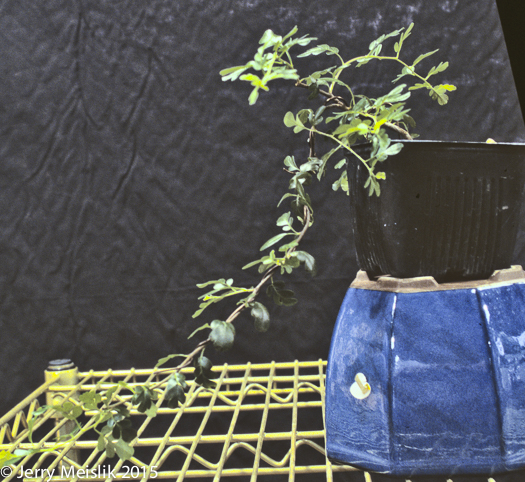
    Cascade style works naturally for this specie’s growth pattern

    The wood once set is quite hard and cannot be bent safely. All bends done with wire must be done in the green stage of the branches. Cut and grow is also an easy way to shape it.

    It has never bloomed for me and it is fascinating that it would tolerate my warm and humid growing conditions and has never been subject to a cool rest period.

    If you can find one it may be a fun plant to play with for your indoor bonsai collection.


    The definitive reference work on Ficus
    for bonsai. The book is a softcover, 8 by 10 inch volume, with 144 color pages, containing detailed information for the beginner as well as the advanced hobbyist.
     Click here for more information

  • Unusual style, Ficus ‘Mexicana’

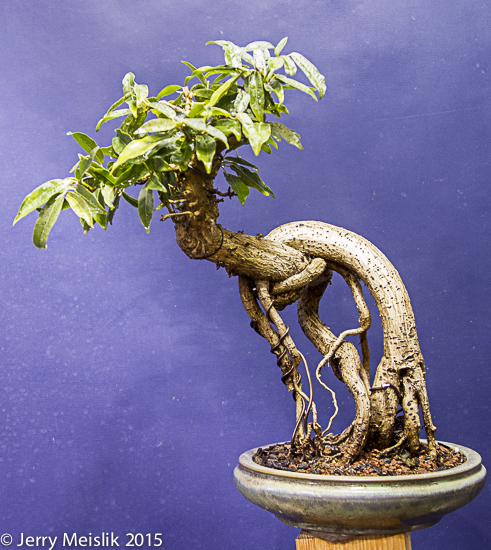
    Exposed root styles are one of may favorites.

    This fig, Ficus that I call ‘Mexicana’ but whose real species name is unknown, is a root cutting of a mother tree. The original material was found in Mexico.

    The exposed roots are interesting to my eye. The canopy is not yet clearly designed. At some future date I may have a better shape for this bonsai.

    For now I enjoy it as an “unusual style”.

    _MG_3356
    Ficus in an exposed root styling

    What do you think?


    The definitive reference work on Ficus
    for bonsai. The book is a softcover, 8 by 10 inch volume, with 144 color pages, containing detailed information for the beginner as well as the advanced hobbyist.
     Click here for more information

  • How I grow a bonsai from a cutting

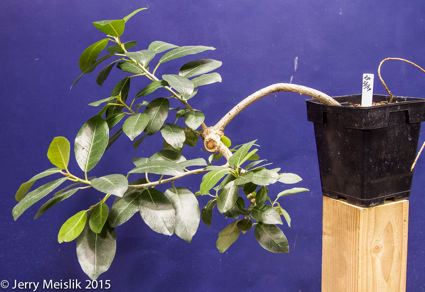
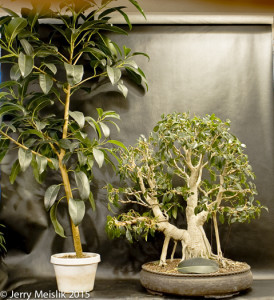
    There are many ways to acquire a bonsai tree. One way is to take a cutting from a suitable material and to propagate it. In this case the mother tree is a Ficus rubiginosa grown form a seed from Australia.

    3_10_6830-2
    Cutting taken from the mother plant about three years before the photo, 2010

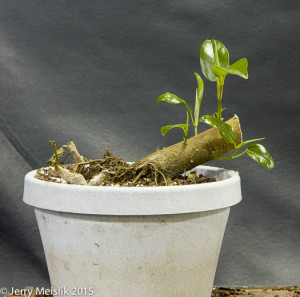
    The mother tree has great bonsai characteristics so a piece of the mother tree was removed and rooted into the large white growing pot. It was allowed to grow wildly for some years and when the trunk caliper seemed about right it was chopped down and tilted to the side.

    It re-sprouted new leaves and branches low down making it suitable for a small bonsai. This re-spouted bonsai was then kept in relatively small pots while the details of the branches and apex were sorted out.

    7_13_107739-2
    New low sprouts made shortening to a small bonsai possible, 2010
    7_13_5963-2
    Branch selection and apex sorting out underway, 2013

    Progress could have been much much faster if I had left the small tree in a much larger pot but space in my indoor growing area is very limited.


    12_14_8801-2
    Further growth and maturation of the design, 2014

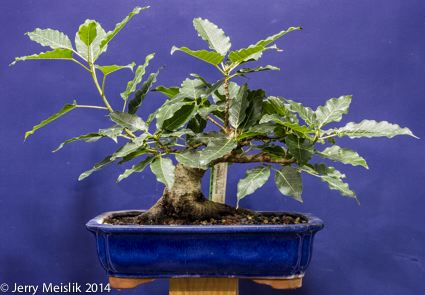
    You can see the result some 5 years later in the last photo. Please remember that this tree is not completed. One, foliage is large and has not been reduced during the training process. More ramification will be produced now that the basic structure has been formed.  Another year or two and the tree will be near completed.

    4_15_3137
    Tree is shaping up well. Leaves are not uniform in size as training is still underway, 2015

    Lesson, developing your cutting into a bonsai in a larger container will help speed of the process, although better control of shaping may be achieved in the smaller container.


    The definitive reference work on Ficus
    for bonsai. The book is a softcover, 8 by 10 inch volume, with 144 color pages, containing detailed information for the beginner as well as the advanced hobbyist.
     Click here for more information

  • Ficus virens Lipstick Ficus, White Fig

    Ficus virens has many common names;  Lipstick Ficus in India and White Fig in Australia. Whatever it is called it is a huge tree growing in its native environment. It can stand alone as a single trunk tree or exist as a strangler fig with many aerials. The most famous trees of this species are the Cathedral fig and the Curtain fig in Australia.

    Ficus concinna is another fig species that has similarities to Ficus virens. It also has red new leaves and is used extensively in the Philippines for bonsai. There it is called Red Balete. Under my care growing in a plant room Ficus concinna is superior to Ficus virens. Ficus virens can lose some fine branches for reasons unknown.

    Ficus virens can make good larger bonsai. Leaves reduce well in container culture. Some cultivars show extensive red or bronze coloring on the new leaves. Unfortunately this lovely red color does not persist for long as it fades into a dark green as the leaves mature.

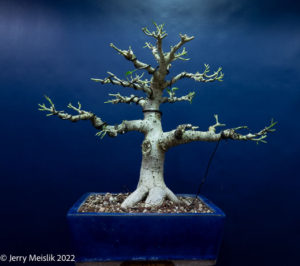
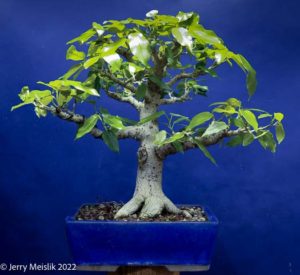
    Ficus virens is not often available as plants in the US so all my trees are grown from seed. The following are all about 11 years old and beginning to show signs of becoming good bonsai. All the trees are under 7-12″ tall or about 30cm.

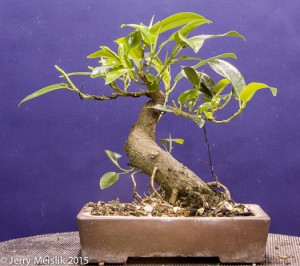
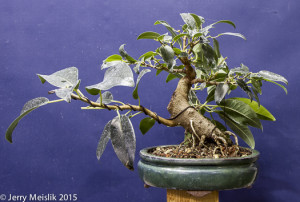
    Photos below are of seed grown Ficus virens. First shot is without leaves to view the branching.

  • Reverse taper

    Trees ideally should have a wide root base that tapers up into the trunk. A bulge or lack of proper taper often ruins the visual flow from the rootline to the apex of the tree and is called reverse taper.

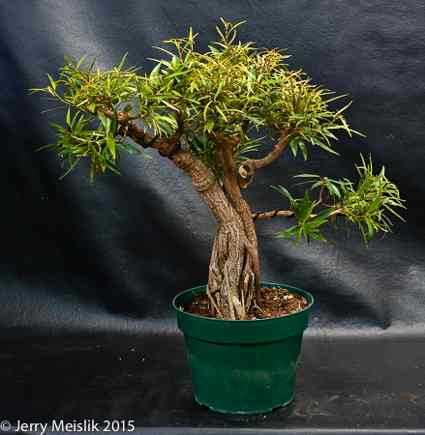
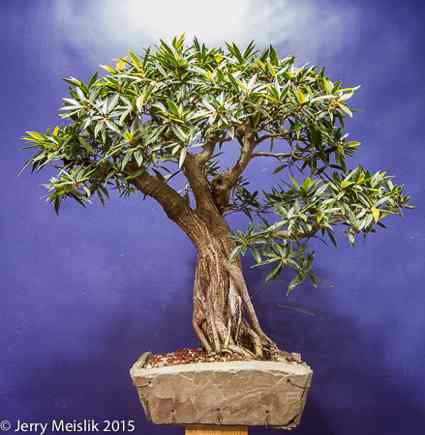
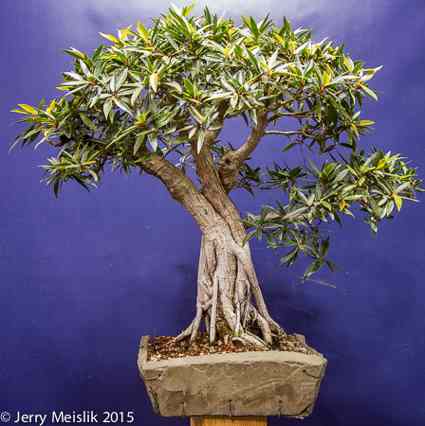
    In this case several root cuttings of Willow Leaf fig, Ficus salicaria, were bound togeter in about 2006 and fused together to form a larger trunk accomplishing  in a shorter time than it woud take to grow the same diameter trunk in my plant room. Fusion was helped greatly by using a large container and allowing free growth of the tree.

    The first shot is taken in 2009 when the fusion was successful but the fusion was not totally complete.

    2009
    2009, with trunks partially fused

    A picture of the tree in 2014 shows good fusion and a reverse taper with the roots and base of the tree appearing narrower at the left side of the base than a bit farther up the trunk.

    2014 showing the left side of the base of the tree with weak footage
    2014 showing the left side of the base of the tree with weak rootage

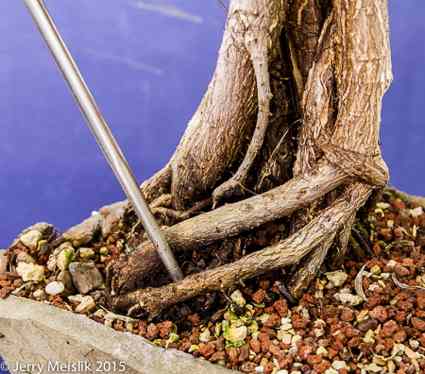
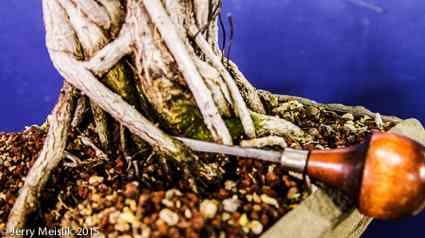
    Three roots were moved around from the left front and left back of the tree. Two of the three roots were fused to other roots at the base and a chisel was needed to separate them from the base, allowing the roots to be moved. One root at the back was just up-rooted and moved around to the left side.

    Back_2998
    The lowest root on the back was simply dug out and easily moved around to the front
    ChiselRts_3013
    Side root is fused to the base – it is separated with a chisel
    2015_3017
    2015, the moved roots now enhance the base of the tree and eliminate the reverse taper


  • Developing a bunjin/literati fig

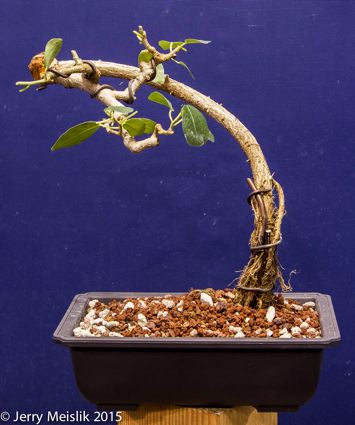
    Starting with this rather young rooted cutting of Ficus ‘Mystery’ I hope to one day develop a bunjin or literati style bonsai. The rooted cutting is now about two years old.

    start_1420-2
    Ficus ‘Mystery’  from an aerial root cutting
    Trim_2853
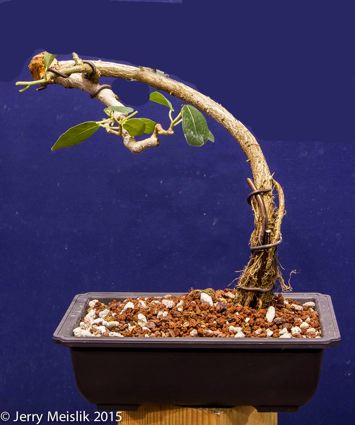
    After a quick trimming a nice line has developed in the trunk. Possibility #1
    3_2853
    Possibility #2
    1_2853
    Possible design #3
    2_2853
    Possible design #4

    Which of the designs seems to be the best to your eye?

    To learn more about bunjin/literati styles see https://suspicious-pike.51-195-201-14.plesk.page/bonsai-culture-and-care/general-bonsai-information/the-bunjin-or-literati-style/


    The definitive reference work on Ficus
    for bonsai. The book is a softcover, 8 by 10 inch volume, with 144 color pages, containing detailed information for the beginner as well as the advanced hobbyist.
     Click here for more information

  • Ficus rumphii, a rare bonsai subject

    This is a Ficus rumphii, an unusual and rare bonsai subject in the west. This specimen is about 8 years old and seed grown.

    Leaves are large but reduce with defoliation. There is some random branch die back suggesting that this may not make the best bonsai subject.

    The bark is a rather stark whitish brown.

    Ficus rumphii, about 12" tall with most leaves removed
    Ficus rumphii, about 12″ tall with most leaves removed


    The definitive reference work on Ficus
    for bonsai. The book is a softcover, 8 by 10 inch volume, with 144 color pages, containing detailed information for the beginner as well as the advanced hobbyist.
     Click here for more information

  • Defoliation of my Ficus rubiginosa, PJ fig

    I have had this fig for many years. In the last year or so I have just pinched out areas that needed restraining and left other areas to grow out to create heavier branches where needed.

    You can see the wide variation in the leaf size depending upon how the branch was maintained.

    _MG_2538
    Ficus with leaves varying from small to large
    _MG_2549
    Now defoliated so that branch posiition can be assessed and wired into position  if needed. New leaves will come in smaller in of uniform size.


  • Ficus ingens, Red Leaved Fig

    Ficus ingens is a fig found in Africa and it is often growing over rocks and is thus called a “rock-splitter”. The leaves are moderately large with a wavy edge and prominent yellowish veins. Its main attraction are the new leaves which come out varying shades of red. The spring flush is a very attractive growth with the tree covered with red leaves.

    As a bonsai it is not the easiest of subjects as its leaves reduce but not extremely well. Branching is not dense so the growth tends to be rather open.

    The red leaf color seems to be accentuated in bright light.

    Leaves are large for this small sized bonsai
    Leaves are large for this small sized bonsai
    _MG_2019
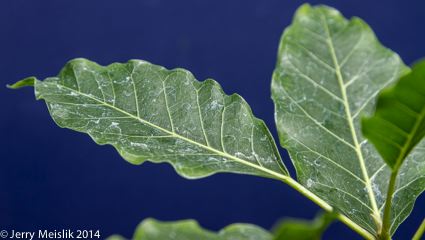
    Leaves are attractive with a wavy edge and prominent main veins
    _MG_2026
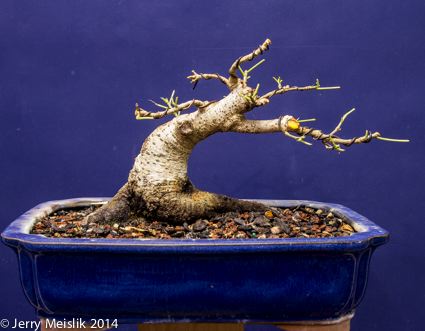
    The bonsai when defoliated shows the beginnings of proper structure for a slant style