Author: Richard

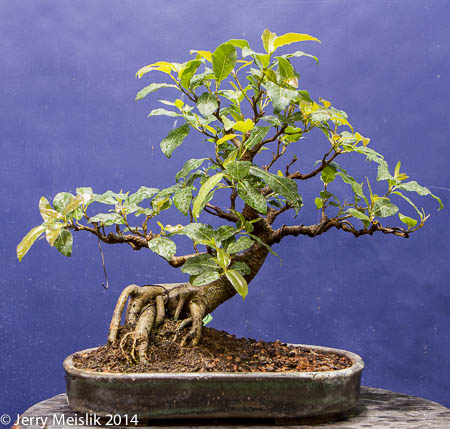
  • Ficus infectoria or is it Ficus virens

    P1010399
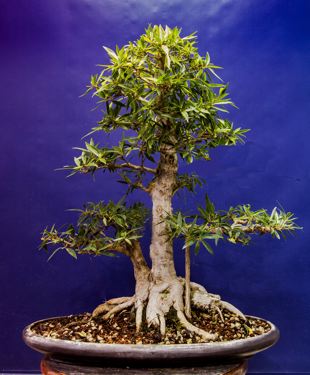
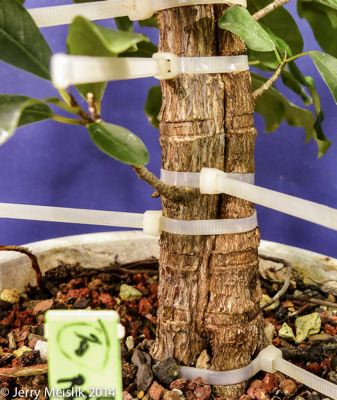
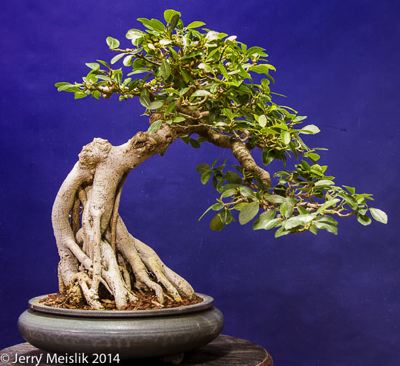
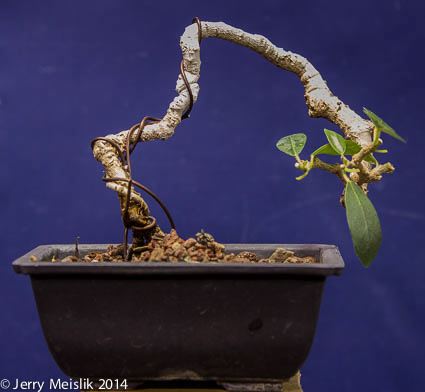
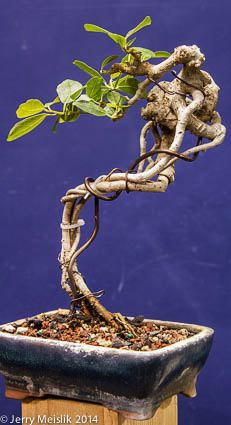
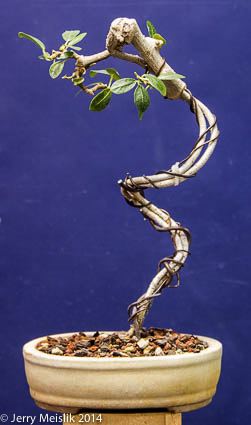
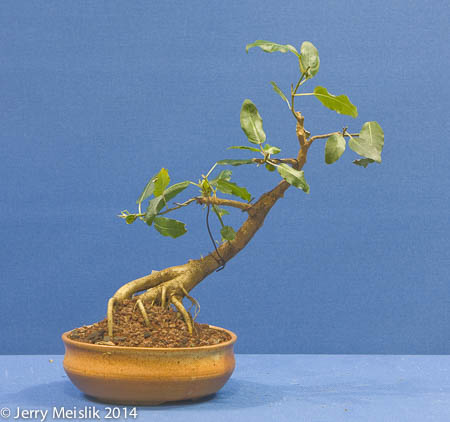
    Multiple trunks fused together from separate seedlings


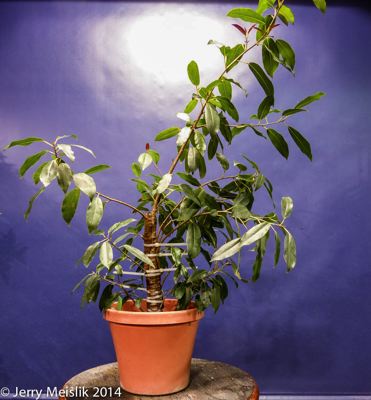
    Ficus infectoria is an invalid name, according to the botanists, and should technically be called Ficus virens. This material shows a coarser grower than some of my other virens. It seems to be quite happy in container culture with no special needs.

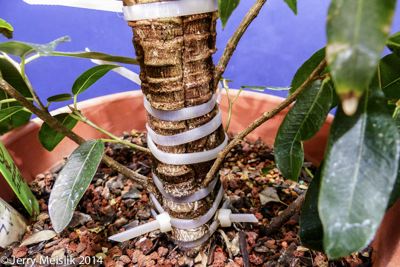
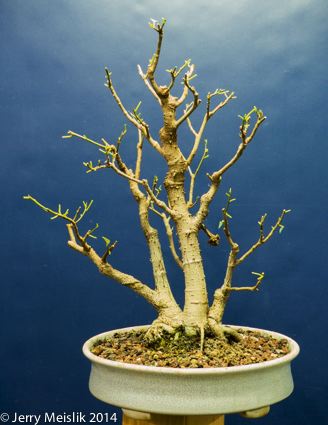
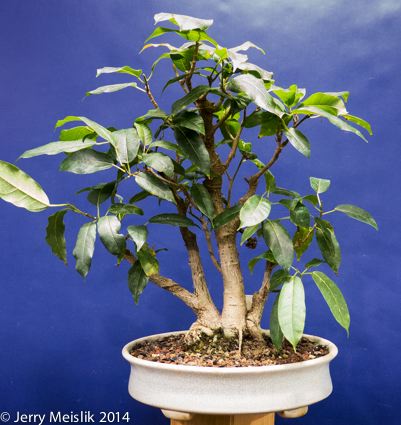
    This bonsai is actually 3 or 4 root fused trees that were grown from seed. The seedlings were never separated to their own containers so that over time the root and bases fused to form one tree.
    P1010405
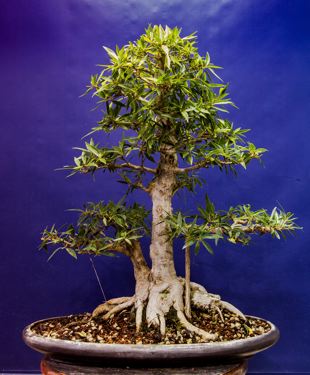
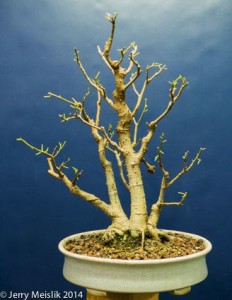
    Defoliated once or twice yearly to improve branching, produce smaller leaves and to allow visualization of the branches

    As the trees grew they naturally fused to each other so that now this is one root connected tree.
     

  • Root cuttings

    Some species of Ficus will grow from pieces of root. This is fortunate as repotting of figs is required every few years to maintain the health of the tree. At this time thick and unnecessary roots can be removed and rooted to form new plants.

    A root cutting is shown from a Willow Leaf fig. The bonsai is now about 10 years old.

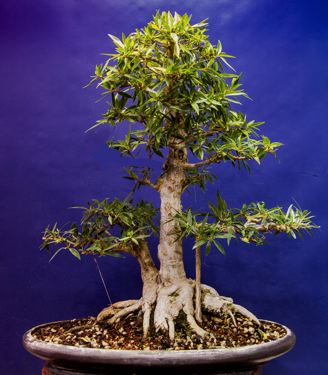
    Willow Leaf fig from the root cutting removed 10 years ago
    Willow Leaf fig from the root cutting removed 10 years ago
    DSCN8853
    This root cutting was removed from a bonsai tree and grew into the above tree


    The definitive reference work on Ficus
    for bonsai. The book is a softcover, 8 by 10 inch volume, with 144 color pages, containing detailed information for the beginner as well as the advanced hobbyist.
     Click here for more information

  • Root-over-rock design

    One of the most popular designs is the root-over-rock design where a tree or trees is growing draped over a stone.

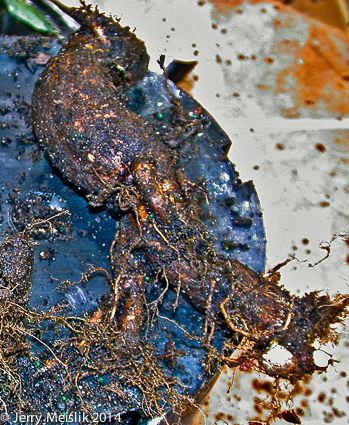
    In this example a Ficus ‘Mystery’ was placed on a rock about 9-10 years ago. It was a piece of a larger plant see http://www.bonsaihunk.us/info/BreakingUpIsEasyToDo.html

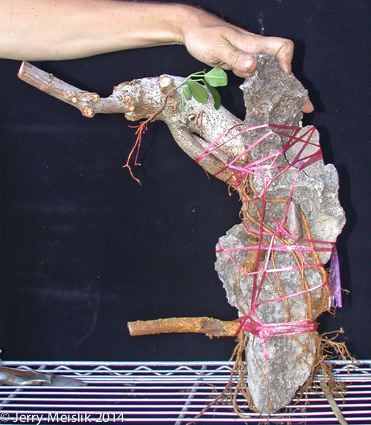
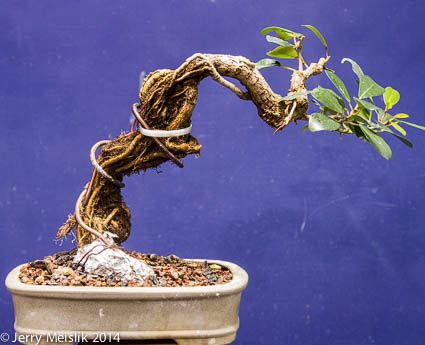
    This section was frankly quite ugly and I almost discarded it. Rather than throwing it away I decided to place it on the rock. It was strapped to the rock with plastic tape and grown for years with most of the rock and the roots buried in soil. Over time the roots and the stone were exposed.

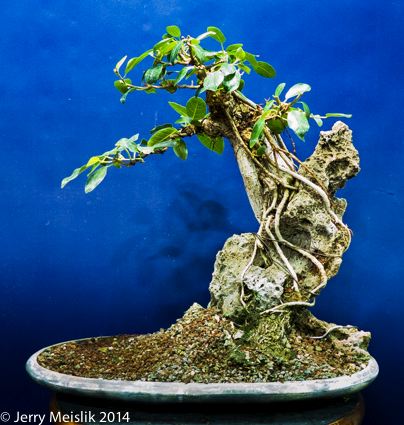
    You can see the result in 2014. The bonsai has improved dramatically and one day may become one of my favorites.

    Frnt2
    The ugly plant was strapped to this stone in about 2004
    P1010420
    The bonsai as seen in 2014

    Root-over-rock designs can be done in many ways but the best and quickest results will be achieved with plants that have super aggressive root systems. Plants that grow slowly and have fibrous root systems generally will not succeed as root-over-rock designs.

  • Bar branches, yes or no?

    One of the most basic beginner rules is to avoid bar branches. That is to say remove one of two branches that appear on the same level but directly opposite each other. This rule as all rules for bonsai or any art form is often helpful in designing a basic bonsai for a beginner. In more mature trees and with mature bonsai artists the rule is often broken. See what you think with with this example.

    _MG_1520L
    Same tree with mid-level lef branch removed
    _MG_1520R
    Now the mid-level right sided branch is removed.

    Which one looks the best is or the best one the original design and keeping the bar branches as you see below?

    _MG_1520
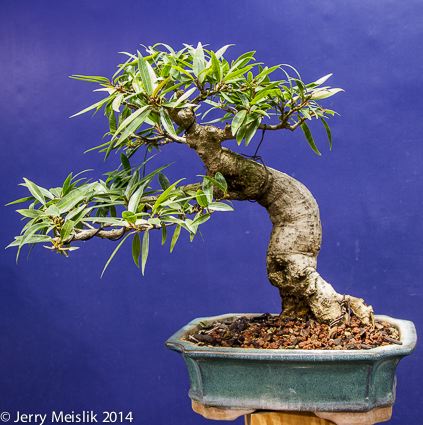
    Willow leaf fig as it exists now


  • Fig leaves

    Ficus or figs are in a large family of plants showing many interesting and varied characteristics.

    One of the most interesting aspects of various figs is the leaf. Leaves can be large, smooth or hairy, glossy or dull and have many, many other variations.

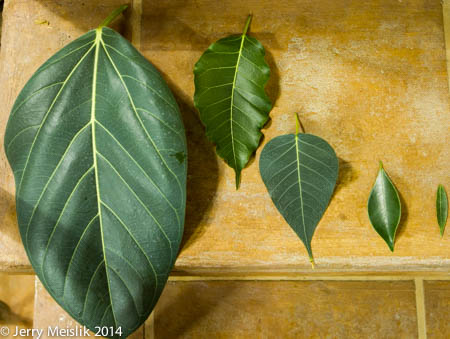
    The photo below shows some fig leaves and their variation. The size of the leaves varies from 7″ to about 1″ on the right. All can be used for bonsai of various sizes depending on how much the leaves can reduce with proper culture and care.

    Fig leaves from the left are benghalensis, ingens, religiosa, microcarpa and salicaria
    Fig leaves from the left are benghalensis, ingens, religiosa, microcarpa and salicaria
  • Fusing figs

    One way to get larger bonsai material is to fuse smaller figs together. Basically tieing together several figs that are genetically identical can produce larger trunks. Growing a tree in a larger container or in the ground will produce faster trunk growth but is often not suitable for indoor growers.

    Fusion is a useful technique for rare or unusual materials and for adding in branches, roots etc. to a fig that needs these parts.

    Bind the trees together with anything that will distribute the compression forces over a wider area to lessen scarring and use a binding material that does not stretch. Allow rampant growth of the materials to speed the fusion.

    Marks left from the electrical ties can be reduced by allowing a year or two of un-restrained growth after the ties are removed.

    For another article on this topic see https://suspicious-pike.51-195-201-14.plesk.page/bonsai-culture-and-care/ficus/creating-a-fused-fig/

    Fzoo440
    Ficus natalensis only one year since the start of fusing
    Fzoo
    Lower trunk with fusion remaining to be accomplished with more growth
    Ficus virens 'Thai' with multiple rooted cuttings pulled together with electrical ties
    Ficus virens ‘Thai’ with multiple rooted cuttings pulled together with electrical ties
    P1000434
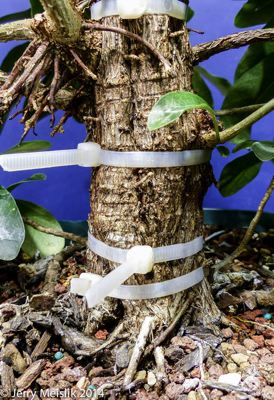
    Close up view of the ties and some marks left from earlier ties that were removed

    P1000450
    Ficus natalensis (type two) allowed wild growth to speed the fusion process
    P1000452
    Close up of the lower trunk showing nicely fusing trees


    The definitive reference work on Ficus
    for bonsai. The book is a softcover, 8 by 10 inch volume, with 144 color pages, containing detailed information for the beginner as well as the advanced hobbyist.
     Click here for more information

  • Ficus ‘Mystery’, piece 4

    Ficus ‘Mystery’ is an unknown fig given to me in 2004 by friend David Fukumoto of Fuku-Bonsai.

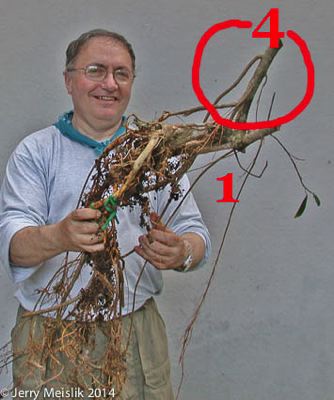
    The first shot shows one of the pieces of the tree that was initially sectioned into 5 pieces.

    The second shot shows the piece #4 in 2014.

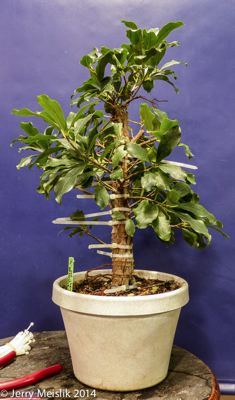
    Ficus 'Mystery' as part of a larger plant, 2004
    Ficus ‘Mystery’ as part of a larger plant, 2004
    P1000219
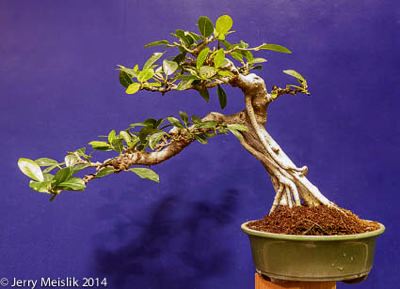
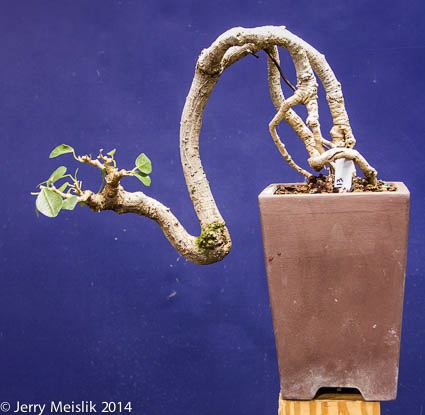
    Piece #4, 2014

    This material is vigorous and aggressive and shapes up into beautiful bonsai. I would recommend it highly to anyone growing figs as bonsai.

    See https://suspicious-pike.51-195-201-14.plesk.page/?p=125 for more about Ficus ‘Mystery’.

  • Two of my Ficus ‘Mystery’, #1 and #2

    Ficus 'Mystery' #1
    Ficus ‘Mystery’ #1

    Ficus ‘Mystery” is so called because its exact scientific name is unclear. No matter what this fig is called it is one of the best figs for bonsai that I have cared for.

    Ficus 'Mystery' #2
    Ficus ‘Mystery’ #2

    You can see how these two figs were created from a tree given to me by David Fukumoto of www.fukubonsai.com by clicking here http://www.bonsaihunk.us/info/BreakingUpIsEasyToDo.html

    One of David’s figs of this species is in the National Bonsai and Penjing Museum in Washington, DC. It is a beauty.

    Let me know how you like mine.


    The definitive reference work on Ficus
    for bonsai. The book is a softcover, 8 by 10 inch volume, with 144 color pages, containing detailed information for the beginner as well as the advanced hobbyist.
     Click here for more information
     

  • Exposed root styles

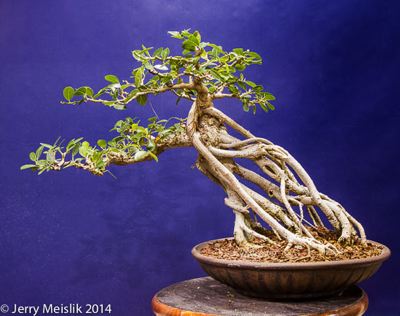
    One of my favorite styles for tropical bonsai is the exposed root style. This may represent trees whose roots have been gradually exposed by a river washing the soil away from the roots or with trees growing on a hillside which is being eroded away. It also could be the end stages of a tree starting life as a strangler or epiphyte and then having the host trunk die and rot away leaving the strangler exposed by itself.

    See how these various figs in this style work for you.


    Ficus natalensis
    Ficus natalensis
    _MG_1355
    Ficus natalensis
    _MG_1365
    Ficus ‘Mystery’
    _MG_1385
    Ficus ‘Mystery’
    _MG_1391
    Ficus ‘Mystery’
    _MG_1403
    Ficus ‘Mystery’


    The definitive reference work on Ficus
    for bonsai. The book is a softcover, 8 by 10 inch volume, with 144 color pages, containing detailed information for the beginner as well as the advanced hobbyist.
     Click here for more information

  • Five years development with a fig

    This bonsai was grown from seed and kept in a small container for its whole life. Development of a bonsai for size will occur most quickly in the ground or in a large container.  Although growing in a large container or ground growing can develop large bonsai often the tree will need finer branching and detailing. This should happen once the bonsai is containerized and nearing its final size.

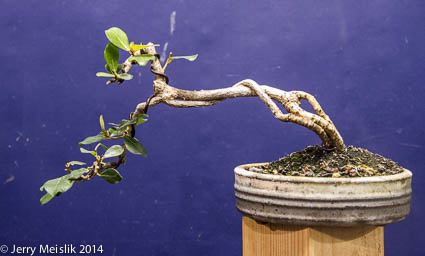
    Slant style grown from seed, 2009
    Slant style grown from seed, 2009
    _MG_9732
    Showing some good branching, 2014

    Now that the size and branching are nearing a reasonable point, leaf reduction and increasing branch density will be next on the list for development.