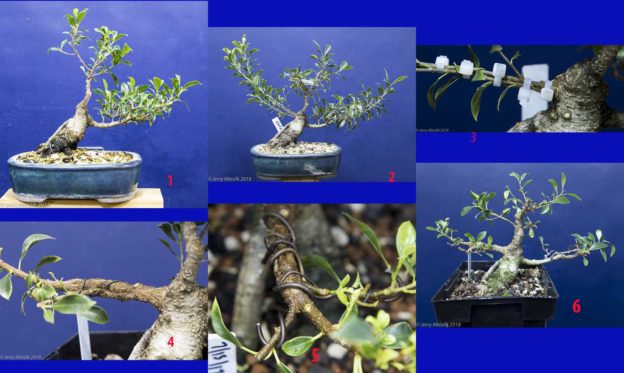
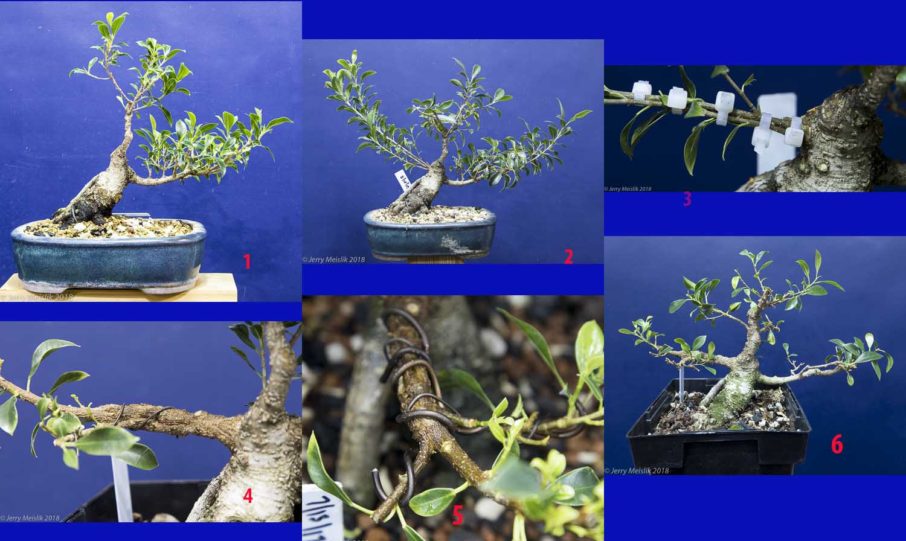
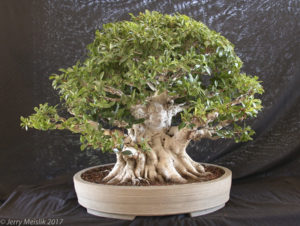
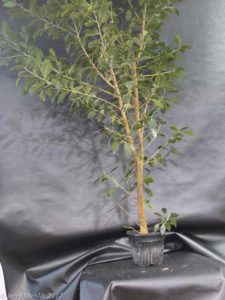
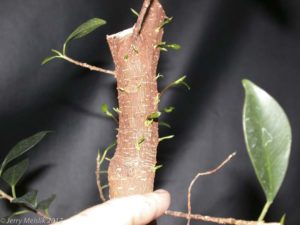
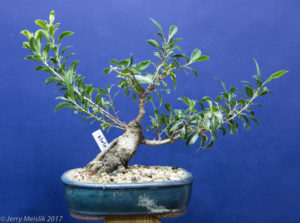
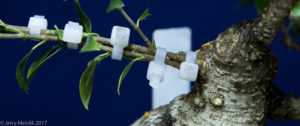
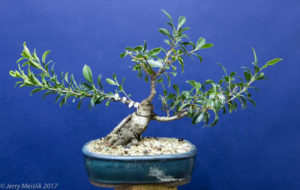
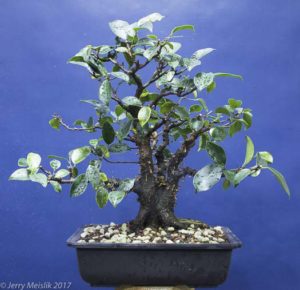
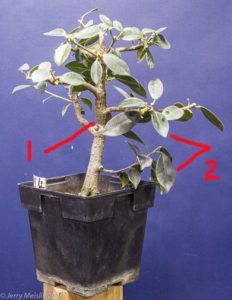
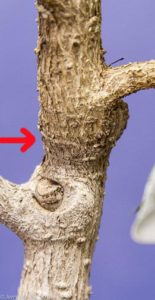
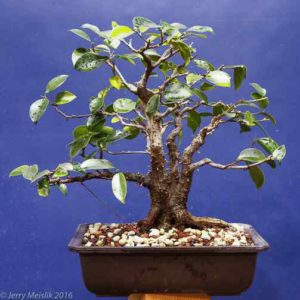
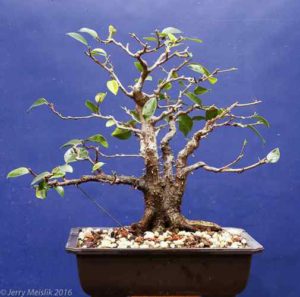
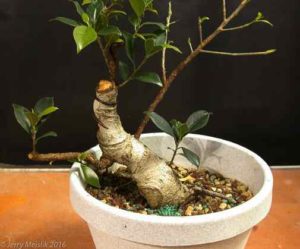
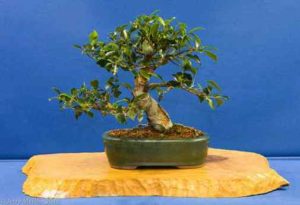
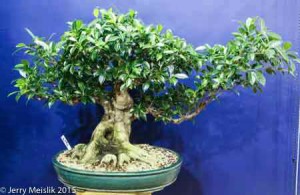
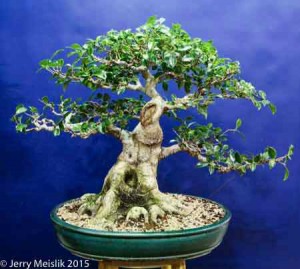
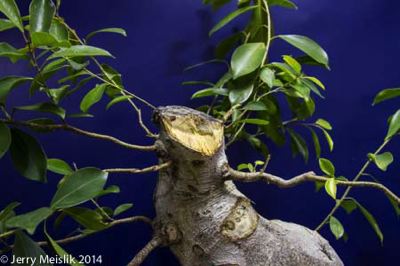
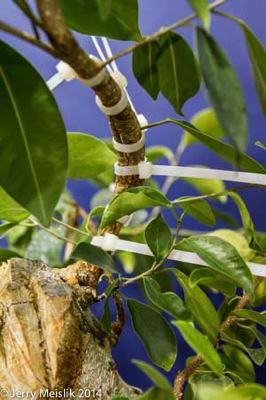
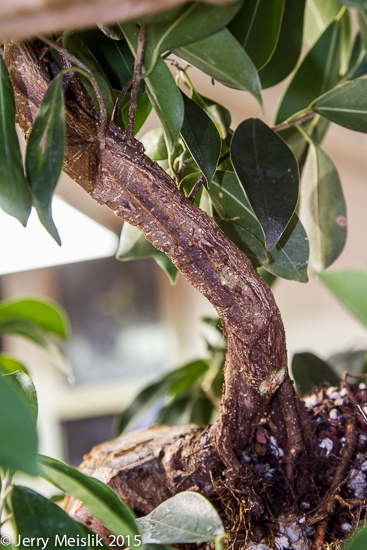
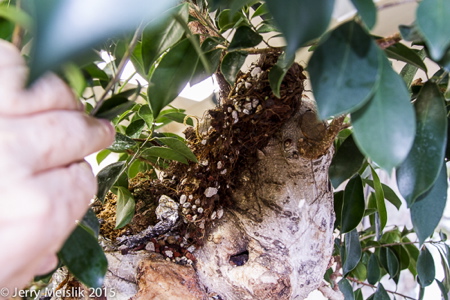
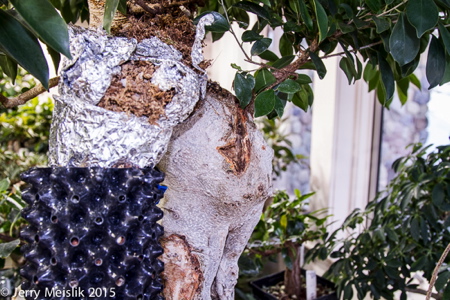
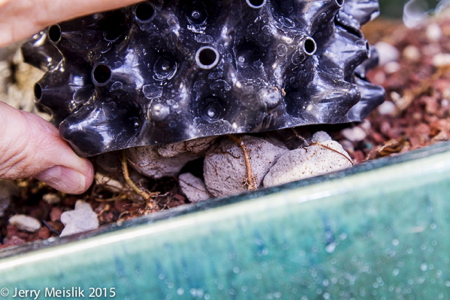
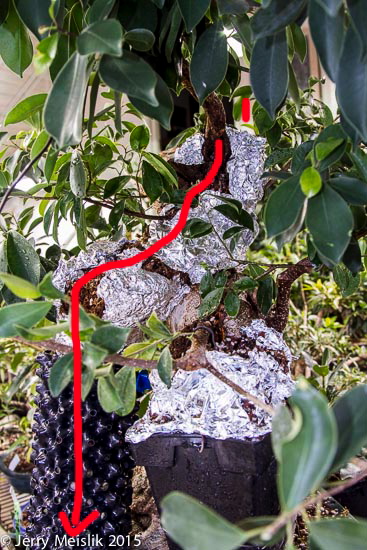
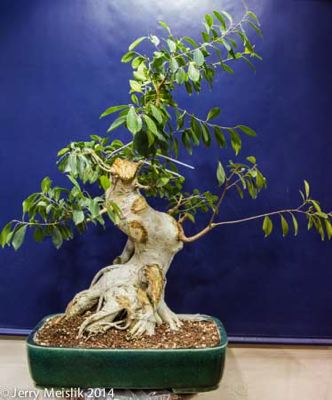
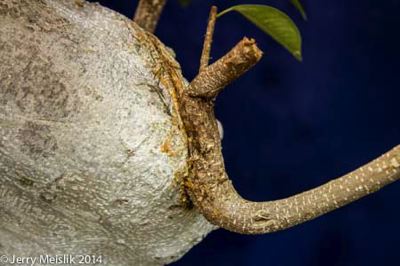
In this Ficus microcarpa ‘melon seed’ I needed a left side branch. As you can see in image 1 there is no branch. Fortunately, several small branches sprouted in the right spot and to speed the development of the branch three of the sprouts were tied together with cable ties, image 2. Two of the branches were brought outward and used to develop side branches. All the branches were allowed to grow and to fuse. Side and front views of the branch show a nicely developing left main branch. Sometimes fusion will allow you to create a heavier and more detailed branch more quickly than with the usual techniques.
Ficus microcarpa ‘melon seed’ progression of fused branch on left
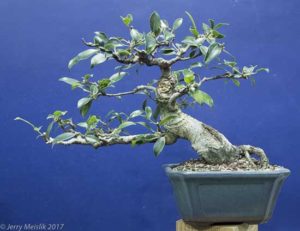
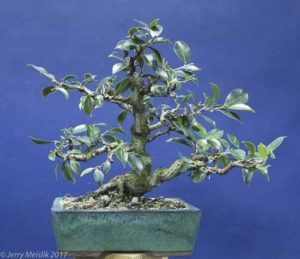
Here are two Ficus microcarpa bonsai of small size. Both were taken from cuttings from one of my large Ficus. They have always been in small pots so their growth has been slow. They are now more than a dozen years since having been harvested. The mother tree has provided many cuttings over the years.
A cutting removed from the mother tree at least 12 years ago
Another cutting removed from the mother tree at least 12 years ago
Ficus microcarpa mother tree
In developing bonsai it is best to first start in larger containers for the early development of structure and size. Once structure and size are nearly completed the plants can be transitioned to bonsai sized containers for their final refinement training.
Sometimes it is desirable to have a heavier branch and the material is grown in a container, indoors or is just a slow growing variety. In this case the material is Ficus microcarpa ‘Melon Seed’. This is a slow growing, miniature leaf form of microcarpa.
In order to develop it as a bonsai I have a good sized right branch but the left side needs a heavier branch. Fortunately, there are several small branches coming out of the left side that can be fused and form a proper sized branch. The apex of the tree is also too thin but there are no other branches that I can use right now to thicken it up.
Ficus microcarpa ‘Melon Seed’ with a nice right branch but a very thin left branch
The left side has several small branches that are pulled together with electrical/cable ties and with time they will fuse
Appearance of the branch now allowed to grow strongly for some months to fuse
I collected and sprouted a seed about 13 years ago that resulted in a plant that had low branches which I decided to keep as secondary trunks. The bonsai is what I would call Clump or Sprout style and is not that common in the bonsai world. It may be close to needing a nice container rather than its plastic development pot. Height is about 10 inches.
Ficus microcarpa, seed grown, in the sprout or clump style
Grafting is a very useful way to improve a fig. It can add branches, new roots or thicken trunks. One factor to keep in mind is to graft identical parts together. Simply use material to graft, the scion, and the stock that are genetically identical. If this is not done the bark and foliage will be a mis-match and not suitable for bonsai.
The graft point is at 1 and the 2 shows that the foliage of the graft and the stock are not the same. Both are Ficus microcarpa but not genetically identical.
Close up of the graft point, 1, shows the mis-match in the bark color and texture
An unusual style for fig trees is the multi-trunk style. One way to develop this style is to use a seedling Ficus and allow several trunks to form. Another way is to fuse several trunks together.
This is a Ficus microcarpa, about 12 years from seed. It spontaneously had several low branches as a seedling and these were developed into a multi-trunk style.
Ficus microcarpa from seed, age about 12 years, height 8″
Nearly defoliated to show the nice structure developing
Over the years I have taken many hundreds of cuttings. Most Ficus can be started easily from cuttings and even large size cuttings can be rooted with success.
Ficus cutting about 8-9 years ago
This is a Ficus microcarpa cutting taken from one of my very large bonsai.
It was allowed to grow without trimming to recover strength and over time branches were selected to keep, other branches were removed and other branches were grafted into areas needing a branch. The bonsai after 9 years of training. Still not completed but it has come a long way from the start.
Years later the same cutting is beginning to be an attractive bonsai
Consider rooting your extra cuttings to use for future bonsai.
The definitive reference work on Ficus
for bonsai. The book is a softcover, 8 by 10 inch volume, with 144 color pages, containing detailed information for the beginner as well as the advanced hobbyist.
This tree is a Ficus microcarpa that has been growing wildly for some months to gather strength and to build up the right lowest branch. Now it is time to get it trimmed back and looking pretty.
Bonsai need periodic wild growth to gather energy and to re-balance parts of the tree that might need more development but then comes the time to bring them back to shape.
The first 5 years of progress with a Ficus microcarpa, Chinese Banyan, was outlined in a previous blog see https://suspicious-pike.51-195-201-14.plesk.page/?s=part+l
This is an update on how this fig has progresse as of April, 2015. It still has some years of refinement to undergo before it can claim its position as a mature bonsai.
Two procedures were accomplished today that are helping bring this bonsai in training a step closer to its end point. One, is to reveal the thickening produced by the second set of fusion grafts of rooted branches that were started 5-6 months ago.
Apex as a single sprout of very thin dimension, allowed to grow wildly to thicken it up, 2013
First set of fusion grafts are successful but not yet thick enough, 2014
Second set of fusions at apex current appearance, 2015
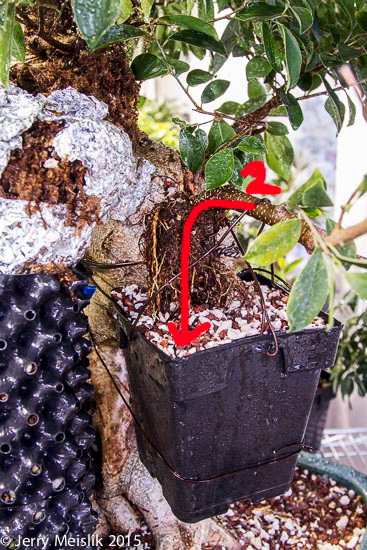
Roots from fusion in moss conduit leading to plastic container to the bonsai pot
Plastic pot of soil leading roots down to the soil in bonsai pot
Roots can be seen growing into the bonsai pot
Red arrow shows the path of the roots from the apex fusions to the bonsai pot
The second procedure was the approach graft on the right . Previously 3 approach grafts were tried and all failed for various reasons. A fourth approach graft was done today to once again try to get a branch established in this position. Since it it is the first branch and lowest branch on the right side of the tree it is crucial to have this set in proper position of good size and of the right shape as it will be key to setting the design of the rest of the bonsai tree.
Bonsai with first branch on right grafted and first set of apex fusions underway at the top of the tree, 2014
Close up of the lowest right graft already established on its own but soon to be accindentally knocked off – planted and grown on its own to become the 4th approach graft
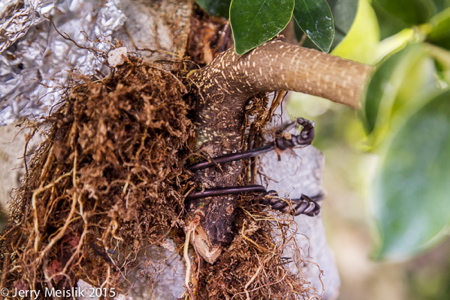
Above cutting, rooted, flipped vertically and graft held to stock with wire
Approach graft’s root are led into the pot of soil, 2015
As of 2015 the process is now 5 years along since started by Jack Pollock and the tree is moving along amazingly well. I am guessing that another 3-5 years will pass by before the tree is an attractive bonsai. In the meanwhile the tree has provided me a lot of reason to continue to learn and grow in the wonders of the bonsai world.
The definitive reference work on Ficus
for bonsai. The book is a softcover, 8 by 10 inch volume, with 144 color pages, containing detailed information for the beginner as well as the advanced hobbyist.